

A status match is one of the few genuine shortcuts in the points and miles game. Instead of flying 40,000 miles to earn status from zero, you show another airline your existing elite card and they grant you the equivalent tier, usually for about 90 days.
Fly enough during the trial and the status sticks. Miss the requirements and it evaporates.
Here is how status matches actually work, how United, Delta, American, Alaska, Southwest, and JetBlue run theirs, and the five rules that decide whether a match is worth your time. Promotions change; the mechanics are evergreen.
Click here for the best cards with the highest welcome offers.
TL;DR
A status match lets you trade elite status with one airline for an equivalent trial tier with another. Almost every version follows the same shape: instant status for roughly 90 days, then a spending or flying requirement to keep it. Here is how the six big US programs compare right now.
| Airline | Trial | To keep | Good thru |
|---|---|---|---|
| United | 90 days | $1.5K-7K spend | Jan 31, 2028 |
| Delta | 3 months | 1,250-3,750 MQDs | Jan 31, 2028 |
| American | 4 months | 13K-67K LP | Membership yr |
| Alaska | 90 days | 5K-20K base pts | Dec 31, 2027 |
| Southwest | 120 days | 3 RT or 6 one-ways | +12 months |
| JetBlue | 3 months | 10-40 Tiles | Next cal. year |
Match terms change over time; always check the airline’s current offer before applying.
What a status match actually is
Airlines would rather steal a competitor’s best customers than win them organically. A status match is the mechanism: prove you hold elite status somewhere else, and the new airline grants you the equivalent tier on a trial basis.
Almost every match follows the same three-act structure. First, you apply with proof of your current status, usually a screenshot of your account or a photo of your elite card. Second, the airline grants you the matched tier for a trial period, typically 90 days. During the trial you get the tier’s published benefits: priority boarding, free checked bags, upgrades, lounge access where it applies. Third, you face a keep requirement. Hit it during the trial and the status extends, sometimes through the following program year. Miss it and the status disappears when the trial ends.
A status match is different from a status challenge. A challenge makes you earn status on an accelerated timeline from zero, with no trial benefits up front. A match gives you the status first and asks you to prove you deserve to keep it. In practice the two blur together, because every match includes a challenge phase. The match is just the version where you fly the trial with perks.
One thing the marketing never says clearly: the trial clock starts when the airline approves you, not when you take your first flight. That single detail decides whether the match works or goes to waste.
How United does it
United runs periodic status match challenges, typically open to elites of competing US airlines. The shape is the standard one: 90 days of the equivalent Premier status on approval, then a spending test to keep it, often through January of the second following year.
As an illustration, a recent United offer mapped tiers this way, with keep requirements from $1,500 in qualifying spend for Silver up to $7,000 for 1K:
| Your status (Delta / American) | United match | Spend in 90 days |
|---|---|---|
| Silver Medallion / AAdvantage Gold | Premier Silver | $1,500 |
| Gold Medallion / AAdvantage Platinum | Premier Gold | $3,000 |
| Platinum Medallion / AAdvantage Platinum Pro | Premier Platinum | $4,500 |
| Diamond Medallion / AAdvantage Executive Platinum | Premier 1K | $7,000 |
Only base fares and carrier-imposed surcharges count toward the spend. Flights must be purchased and flown on United or United Express inside the 90-day window. United promises approval within three business days.
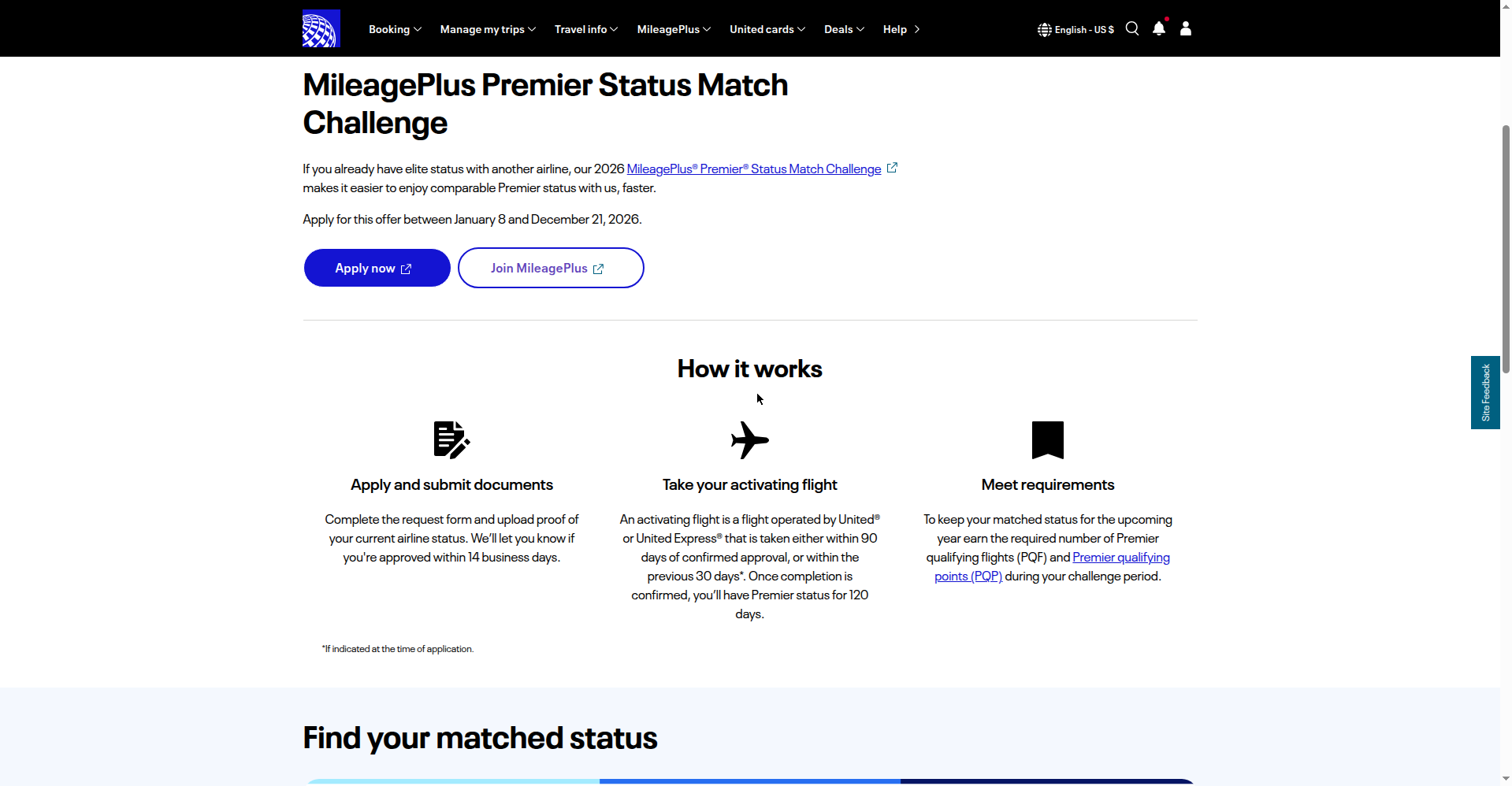
Two details matter more than the headline. First, the spend that counts is narrower than people expect: base fares and carrier-imposed surcharges on United or United Express flights, purchased and flown inside the 90 days. Award tickets, partner flights, and taxes do not move the needle. Second, matched status lives under the airline’s normal qualification rules going forward. If you are considering United long term, the 2027 points-only overhaul belongs in the same decision. I broke it down here (United’s 2027 elite overhaul).
A point worth being honest about: United’s offers are typically open to US residents with earned status, and they exclude status that came from a trial or promotion. If your current tier itself came from a match, expect to be ineligible. Matches almost never stack.
How the other big US airlines do it
United’s promo is the loudest match on the board, but the mechanism runs year-round at most carriers. The shapes differ in ways that matter.
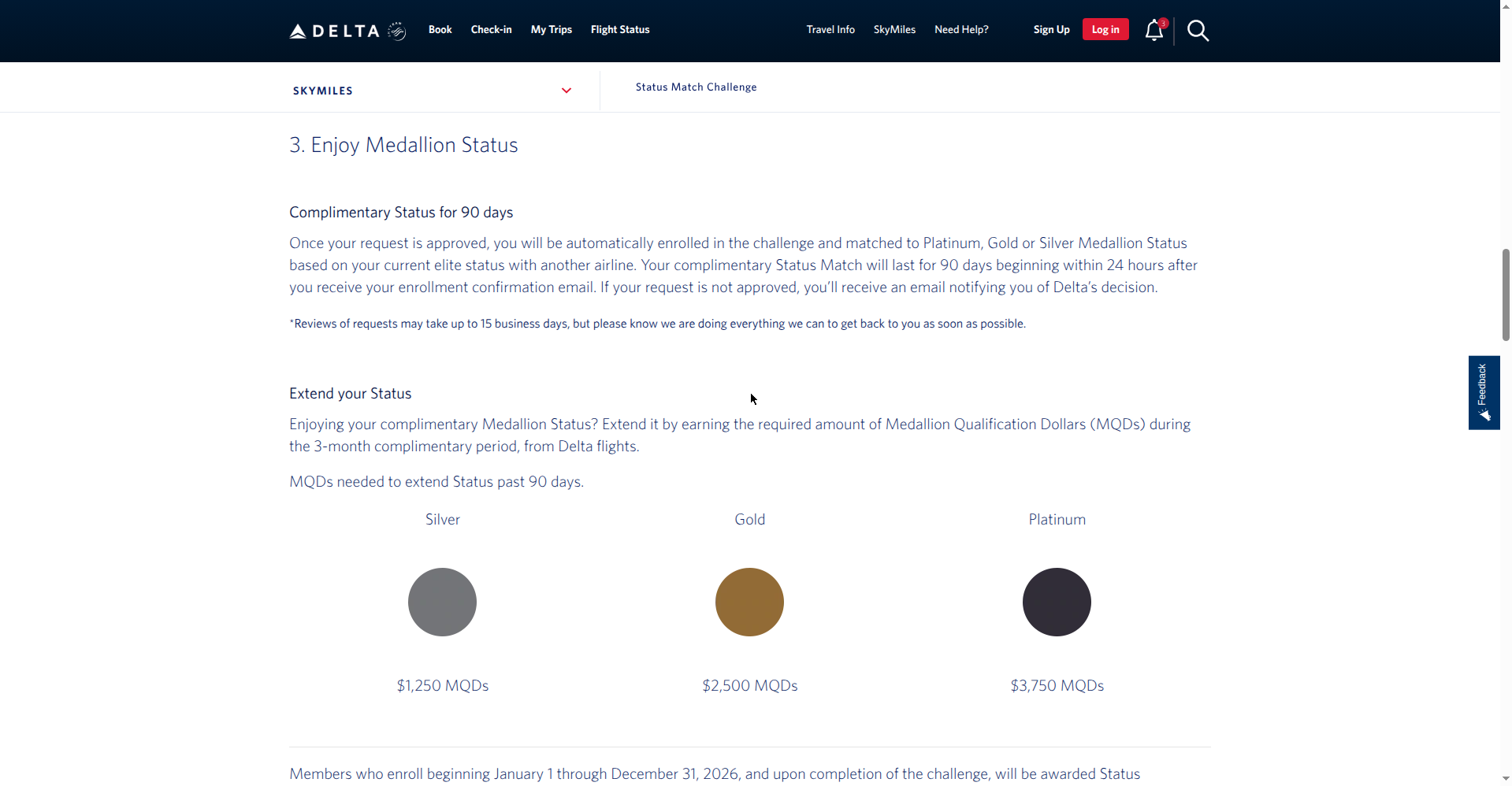
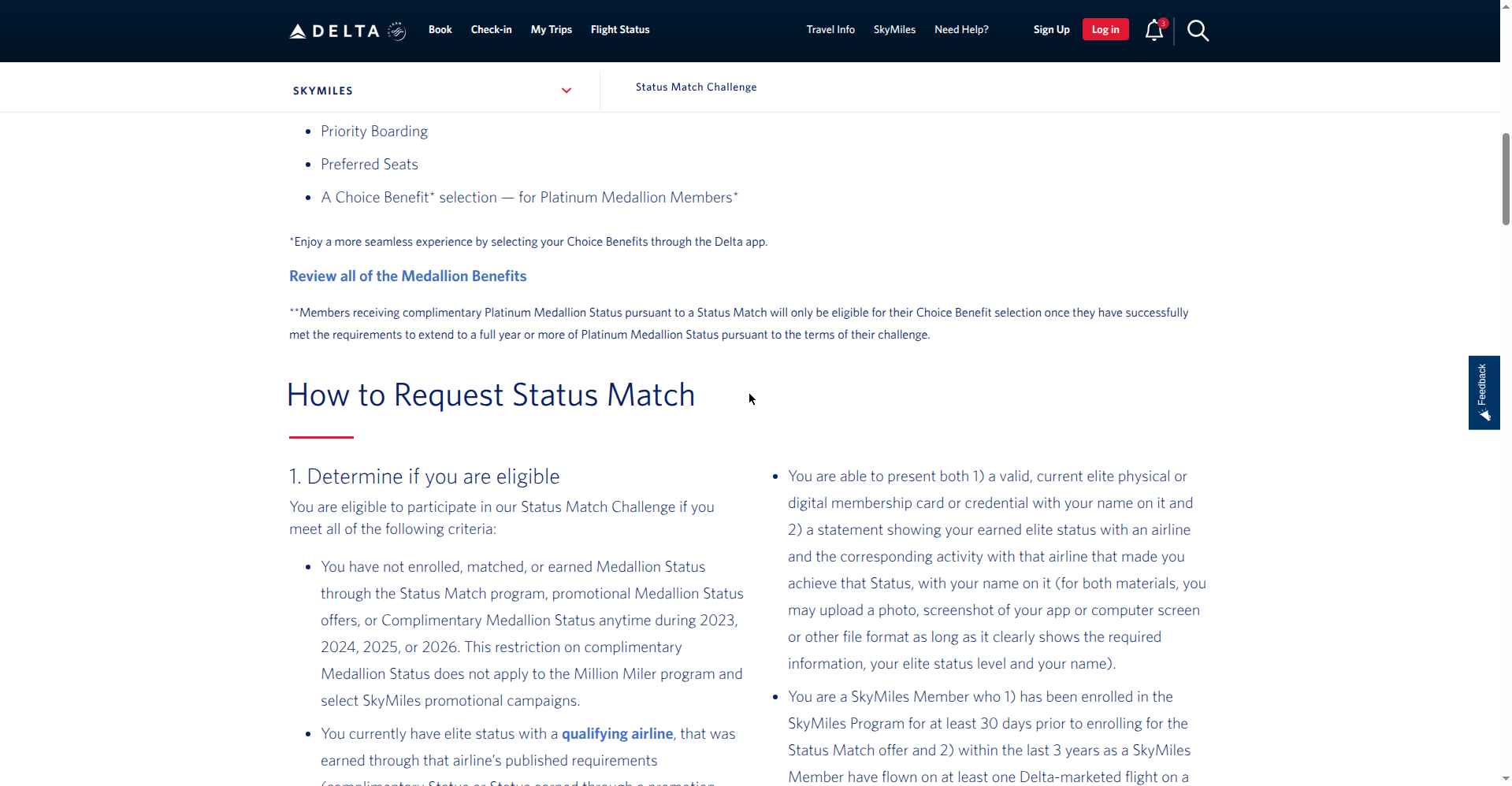
Delta matches up to Platinum Medallion for three months. To extend, you earn Medallion Qualification Dollars in the trial: 1,250 MQDs for Silver, 2,500 for Gold, 3,750 for Platinum. Enroll and complete the requirements in 2026 and your status extends through January 31, 2028. Delta bars anyone who received a Delta match in the past three years, and you have to prove your status was earned from flying, not from another match. Delta also runs a separate “Reclaim My Status” program for members who lost status after a major life event, which works on the same trial-plus-challenge shape.
American runs its match as the Instant Status Pass, a three-phase program where each phase lasts four months. You get the matched tier immediately, then must earn a prorated Loyalty Point goal to keep it another four months: 13,000 LP for Gold, 25,000 for Platinum, 42,000 for Platinum Pro, 67,000 for Executive Platinum. Hit all three phases and you hold the status for the membership year. Eligible incoming programs include Delta, United, JetBlue, Southwest, and Spirit. American is the friendliest of the big three for cobranded credit card spenders, because Loyalty Points can come from flying, partners, and card spending.
Alaska is the one to handle with care, because its match is once per lifetime of your account. Approval grants 90 days of the equivalent Atmos Rewards tier, and keeping it means earning base points on Alaska- or Hawaiian-operated flights: 5,000 for Silver, 10,000 for Gold, 20,000 for Platinum. Start the match between July and December and complete it, and your status runs through December 31 of the following year, which right now means through the end of 2027. Eligible programs include Delta, United, Southwest, JetBlue, Frontier, Aeroplan, and Aeromexico. Titanium, the top tier, is not offered as a match. Because you get exactly one of these, timing is everything: line it up with a stretch of real Alaska flying and a second-half start.
Southwest offers a 120-day promotional A-List or A-List Preferred status to elites of other US-based airlines, with registration open through December 30, 2026 on Southwest’s own promotion page. To extend for 12 months, fly three paid round trips or six paid one-way flights within the 120 days, or earn 11,500 tier qualifying points for A-List (23,000 for A-List Preferred). You cannot enroll more than once in a twelve-month period, and Southwest says to allow up to 12 business days for processing.
JetBlue matches to Mosaic 1 or Mosaic 2 from programs including Alaska, American, British Airways, Delta, Frontier, Southwest, and United. You get three months of complimentary Mosaic status, then need Tiles to keep it: 10 Tiles to keep Mosaic 1, 25 for Mosaic 2, and 40 to level up to Mosaic 3. Application is a screenshot of your frequent flyer profile showing your name and status; matching to Mosaic 2 also needs a recent boarding pass or flight confirmation.
The five rules of status matching
Every match I have covered follows the same underlying logic. These five rules decide whether a match pays off or quietly wastes your one shot.
1. You need genuinely earned status. Trial and promotional status almost never qualifies. United excludes it, Alaska excludes complimentary status, Delta requires proof your status came from flying. If your current tier came from a match or a promo, fix that first or expect a rejection.
2. Most matches are one-shot. Alaska gives you one per lifetime. Delta makes you wait three years. Southwest allows one enrollment per twelve months. Treat every application like it is your only one, because for Alaska it literally is.
3. The clock starts on approval. The 90 days (or three months, or 120 days) run from when the airline approves you, not from your first flight. Do not apply until you have real travel on that airline already planned inside the window. An approved match with no flights is a burned match.
4. The keep requirement is the real price. The trial is free; the status is not. United wants $1,500 to $7,000 in qualifying spend. Delta wants thousands of MQDs. Alaska wants base points on its own metal. Run the keep math against your actual travel before you apply. If you cannot see yourself hitting it naturally, the match buys you a nice three months and nothing more.
5. Match an airline you would actually fly. Matched status on an airline with no routes from your home airport is decoration. The best match in the world is the one where the trial period overlaps with trips you were already going to take.
The honest caveats
Status matches are a real shortcut, but the fine print has teeth.
First, trial status is not always full status. You get the tier’s day-to-day benefits during the trial, which is the whole point, but perks tied to completing a full qualification year, like choice benefits or systemwide upgrade instruments at some programs, may not come along. Read the match terms for your specific tier rather than assuming.
Second, the deadlines on promos are real and short. Limited-time matches do not get extended because you meant to apply. If a deadline is inside 48 hours, decide today.
Third, a match does not stack on a match. Airlines check whether your status was earned. The whole point of the exercise is poaching genuinely loyal flyers, so status that itself came from a trial or promotion is disqualified at most programs.
Fourth, keeping matched status can cost more than earning it normally would have. United’s $7,000 keep requirement for 1K is real money, and it only counts base fares and carrier surcharges. If you were going to fly United anyway, it is a discount. If you are manufacturing trips to hit it, do the math twice.
Finally, Alaska’s once-per-lifetime rule makes it the match to time most carefully. A United or Delta match can come around again in a few years. Alaska gives you one application ever. Second-half timing, lined up with real travel, is the difference between 18 months of status and 90 days.
My take
Status matches are the highest-leverage play in elite status, full stop. Nothing else gives you three months of priority boarding, free bags, and upgrades for the price of a screenshot and an application form.
United’s matches are worth a hard look whenever they run: every tier is usually covered and approval is fast. The honest filter is whether you fly United. If United is already in your rotation, run the keep math on your real bookings before applying. If you are matching just because an offer exists, you are buying a 90-day trial of an airline you do not fly.
The one I would guard most carefully is Alaska’s. Once per lifetime, 90 days on approval, and a second-half start that stretches the keep through the end of next year. That is an 18-month status play hiding inside a 90-day trial, and it deserves to be spent on a year when you genuinely fly Alaska or Hawaiian.
Frequently Asked Questions
Does getting a status match affect my original status?
No. Your status with your home airline is untouched. A match is a one-way grant: the new airline gives you a trial tier based on proof of your existing one. You keep both during the trial. The programs do not communicate with each other about it, and nothing about applying puts your earned status at risk.
Can I status match more than once?
It depends on the airline. Alaska allows one status match per lifetime of your account. Delta requires a three-year gap between matches. Southwest allows one enrollment per twelve months. United’s regular match policy has its own frequency limits, though limited-time promotions can waive them. Assume each match is a scarce resource and spend it accordingly.
Do I get all the tier’s benefits during the trial period?
You get the tier’s published day-to-day benefits: priority check-in and boarding, free checked bags, upgrades, and lounge access where the tier includes it. Perks tied to completing a full qualification year, such as choice benefits or upgrade instruments at some programs, may be excluded from matched status. Check the match terms for your specific tier before counting on any single perk.
What if I already have status with the airline I want to match to?
You are generally not eligible. Status matches are a customer-acquisition tool aimed at flyers loyal to someone else. If you already hold status with the airline, the match page will usually reject you or direct you to a challenge instead. Some airlines will let you match to a higher tier than the one you hold, but that is the exception, not the rule.
What is the difference between a status match and a status challenge?
A status match grants you the tier immediately for a trial period, then asks you to hit a requirement to keep it. A status challenge makes you earn the tier from scratch on an accelerated timeline, with no trial benefits up front. Every match includes a challenge phase (the keep requirement), so the practical difference is whether you enjoy the perks during the trial. Matches are the better deal whenever you qualify.
Bottom Line
A status match is elite status on a trial basis: prove your tier elsewhere, get roughly 90 days of the equivalent tier, and hit a flying or spending requirement to keep it. United, Delta, American, Alaska, Southwest, and JetBlue all run their own versions, with Alaska’s once-per-lifetime match deserving the most careful timing. Apply only when you have real travel planned inside the trial window.
Related Reading: United’s 2027 Elite Overhaul: What the Points-Only Rules Mean for You, the 2027 qualification changes your matched status will live under; Do Airline Miles Expire? The 2026 Guide to Every Expiry Rule, because status and miles run on different clocks.
Save your one shot for the year you actually fly the airline.
View comments
+ Leave a comment