

Rove is not a credit card. It is a free rewards platform where you earn miles by booking travel, shopping, dining, and buying gift cards, and this morning it added JetBlue TrueBlue as a 1:1 transfer partner. To celebrate, every transfer to JetBlue gets a 20% bonus through November 14, 2026.
That 1:1 ratio matters. Early coverage notes it ties the best ratio any transferable currency offers to TrueBlue, matching Chase and Citi at 1:1. And the bonus turns 10,000 Rove Miles into 12,000 TrueBlue points for the next month.
Here is what Rove is, what changed, the math on real routes, and the honest catches, including the one about how JetBlue prices awards.
Click here for the best cards with the highest welcome offers.
TL;DR
| Term | What it is |
|---|---|
| New partner | JetBlue TrueBlue, Rove’s 22nd transfer partner |
| Ratio | 1:1, tying the best ratio any transferable currency offers to TrueBlue |
| Launch bonus | 20%, through Nov 14, 2026, 11:59 p.m. ET |
| Bonus math | 10,000 Rove Miles become 12,000 TrueBlue points |
| Minimum | 2,000 miles, in increments of 100 |
| Bonus posting | Typically within 1 business day |
| Transfers | One-way and final, cannot be reversed |
Terms from Rove’s launch announcement and current coverage, verified October 15, 2026.
What Rove is
If Rove is new to you, you are not behind. It is a free travel rewards platform, not a credit card, and you earn Rove Miles through things you already do: booking hotels and flights through Rove, shopping, dining, buying gift cards, and referrals. There is no credit card to open and no annual fee to justify. If you have not tried it yet, you can sign up with my referral link.
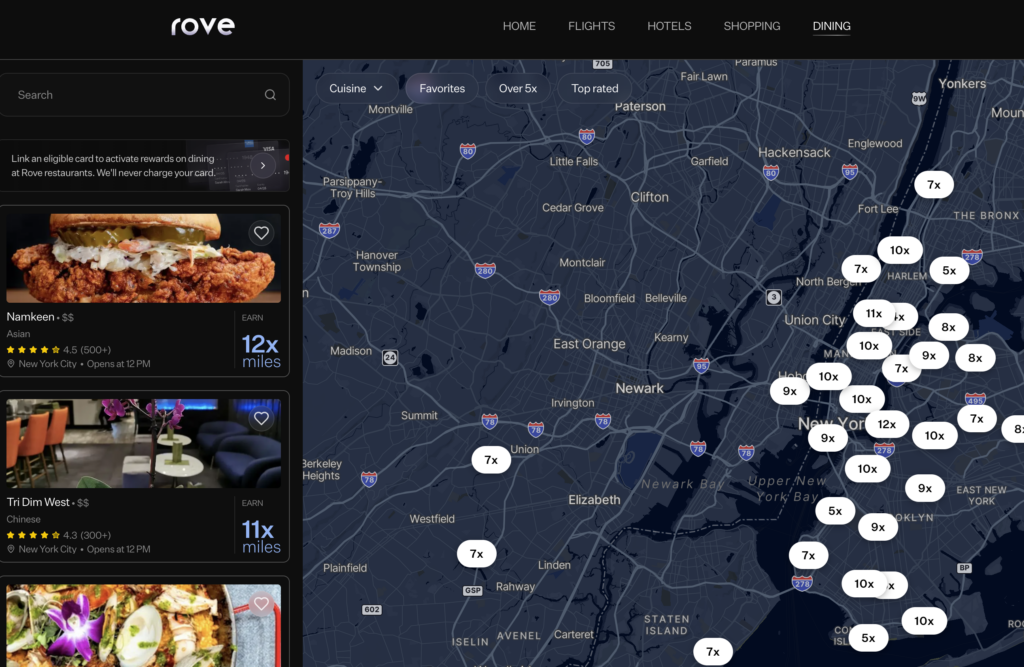
Rove is US-only, and account verification uses a US phone number.
The platform has been adding transfer partners at a fast clip. Air Canada Aeroplan joined in May, Frontier Miles in July, and JetBlue TrueBlue is now partner number 22. Three other Rove transfer bonuses are running at the same time, 50% to Japan Airlines, 40% to Flying Blue, and up to 35% to Qatar, but all three end October 31. The JetBlue bonus runs about two weeks longer, through November 14.
What actually changed
As of today, October 15, 2026, Rove members can move Rove Miles to JetBlue TrueBlue at a 1:1 ratio. This is a genuinely new partnership, not a bonus layered onto an existing one. JetBlue was not a Rove partner before this morning.
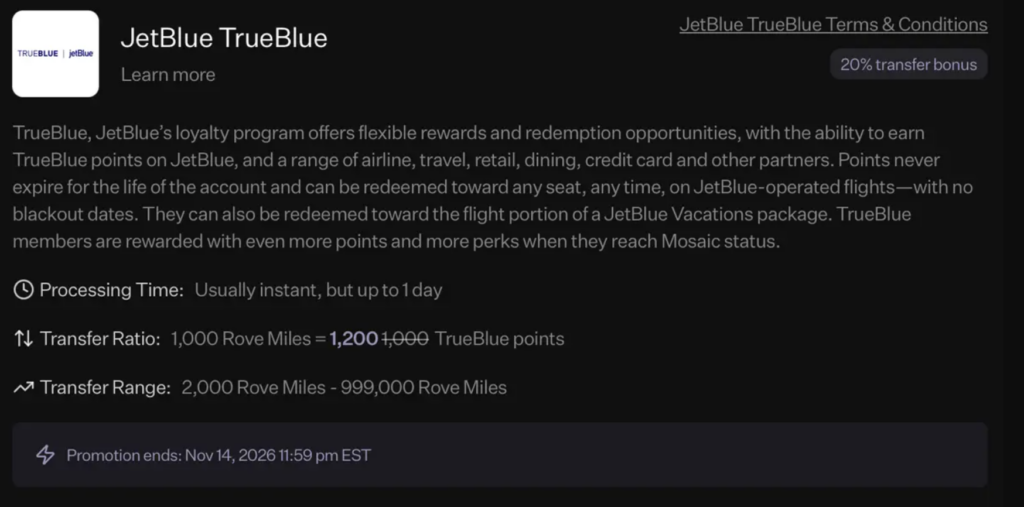
The 1:1 ratio is the headline because it ties the best ratio any transferable currency has to TrueBlue, matching Chase and Citi at 1:1, per current coverage. Then the 20% launch bonus makes it better: every 1,000 Rove Miles becomes 1,200 TrueBlue points, every 10,000 becomes 12,000, through November 14 at 11:59 p.m. ET.
A point worth being honest about, because it trips people up: the 1:1 ratio is permanent, the 20% is not. If you transfer on November 15, you still get a 1:1 rate that ties the best anyone offers to TrueBlue. You just do not get the bonus.
The math on real routes
TrueBlue prices awards off cash fares, so every example below is an illustration from current coverage, not a price I can promise you next Tuesday. Award prices move daily. With that said, here is what the bonus buys on routes people actually fly:
| Route | TrueBlue price | Rove, with bonus | Rove, no bonus |
|---|---|---|---|
| JFK to Dominican Republic, each way | 3,800 pts | About 3,200 | 3,800 |
| Transcontinental, each way | 11,500 pts | About 9,600 | 11,500 |
| Mint, long-haul domestic, each way | Under 32,000 pts | Under 26,700 | Under 32,000 |
| 100,000 Rove Miles | 120,000 pts | 120,000 pts | 100,000 pts |
Illustrative pricing from current coverage; TrueBlue prices move with cash fares. Rove equivalents divide by 1.2, rounded to transfer increments of 100.
The JFK to Santo Domingo example is the cleanest way to see it. 3,800 TrueBlue points each way is a genuinely cheap Caribbean hop, and the bonus gets you there for about 3,200 Rove Miles instead of 3,800. That is 600 miles saved per direction on a flight people take all winter.
One more math frame, because the bonus math matters here. TrueBlue points are generally worth about 1.3 to 1.4 cents each toward JetBlue flights. Without the bonus, 10,000 Rove Miles become 10,000 TrueBlue points, about $130 to $140 in flight value. With the 20% bonus, those same 10,000 Rove Miles become 12,000 points, about $156 to $168. The bonus does not change what a TrueBlue point is worth. It changes how many of them your Rove Miles buy.
How to use it
The playbook is the same booking-first discipline I always recommend with transfer bonuses:
- Price the JetBlue flight first. Search your dates on jetblue.com and note the points price. TrueBlue tracks cash fares, so a cheap cash fare means a cheap award.
- Check the points price against the cash fare. If the points price looks bad relative to cash, the 1:1 ratio will not save you. Transfer only when the award price beats paying cash.
- Transfer in increments of 100, minimum 2,000. Your Rove Miles leave your account immediately, and the maximum per transfer is 999,000.
- Wait for the bonus if you need it. The bonus typically posts within 1 business day, not instantly. If your booking depends on the bonus points, do not start the booking until they land.
- Book on jetblue.com. Transfers are one-way and final, so only move what the booking needs.
I keep a running list of every live bonus, this one included, on my transfer bonus tracker.
The honest caveats
TrueBlue has no award chart, so there are no sweet spots to hunt. JetBlue prices awards off cash fares. That is the single most important thing to understand before you get excited about the 1:1 ratio. A great transfer ratio into a revenue-based program is worth exactly what the fares say it is worth, nothing more. The Mint example above is the closest thing to an outsized redemption, and even that tracks the fare.
The cheapest award prices come with Basic fare restrictions. The under-4,000-point economy awards and the sub-32,000-point Mint awards are usually Basic rates: no free seat selection, and fees to change or cancel. Standard and Flex rates cost more points for the same seat. Price the fare class you would actually fly before you transfer.
Transfers are one-way and final. This is true of nearly every transfer bonus, and it is the rule that burns people. Once Rove Miles become TrueBlue points, they cannot come back. The booking-first playbook above is the entire defense.
The bonus is fast, but not instant. Bonus points typically post within 1 business day. That is quicker than most bank bonuses, but if you transfer at midnight before a fare you are watching disappears, you are gambling on the timing.
Partner redemptions exist but are not the play. TrueBlue points can book partner airlines like United, Qatar Airways, and Etihad, but you cannot mix JetBlue and partner segments on a single award, and coverage has not found a true sweet spot in partner pricing. Treat this partnership as a JetBlue-flight play.
Rove is US-only. If you are outside the US, none of this applies to you. The platform requires a US phone number for verification.
My take
This is a good deal for a specific person: someone who already holds Rove Miles and already flies JetBlue. For that person, the next month is the cheapest TrueBlue points will ever be, because 1:1 already ties the best ratio anyone offers and the 20% is a limited-time kicker on top.
I would not earn Rove Miles from scratch just for this unless JetBlue is already your airline. TrueBlue is a solid domestic and Caribbean currency, but it is revenue-based, which means there is no aspirational business-class-to-Europe sweet spot hiding in here the way there is with Avios or Flying Blue. The honest version of this deal is “20% off JetBlue flights you were going to take,” and that is plenty.
The honest caveat I keep coming back to: a transfer bonus cannot fix a bad award price. Price the flight, compare it to cash, and only then move the miles.
Frequently Asked Questions
Is Rove a credit card?
No. Rove is a free rewards platform, not a credit card. You earn Rove Miles by booking hotels and flights through Rove, shopping, dining, buying gift cards, and referring friends. There is no annual fee and no application. It is currently available to US residents only.
When does the 20% JetBlue transfer bonus end?
November 14, 2026, at 11:59 p.m. ET. The 1:1 transfer ratio is permanent and continues after the bonus ends, so transfers after that date still move at 1:1, just without the extra 20%.
How fast do Rove to JetBlue transfers post?
Your Rove Miles are deducted immediately when you submit the transfer. The 20% bonus typically posts within 1 business day. If your booking needs the bonus points to cover the fare, wait until they land before starting the booking.
Do JetBlue TrueBlue points expire?
No. TrueBlue points never expire, and JetBlue-operated award flights have no blackout dates. That makes TrueBlue one of the safer places to park a transfer while you finalize plans, which I covered in more detail in my guide to airline miles expiry rules.
Can I transfer TrueBlue points back to Rove or to another airline?
No. Transfers from Rove to JetBlue are one-way and final. TrueBlue points cannot be moved back to Rove or onward to another program, which is why the booking-first rule matters: only transfer the miles for a flight you have already priced. My transfer bonus guide walks through the five rules that keep transfers safe.
Bottom Line
Rove to JetBlue at 1:1 with a 20% bonus through November 14 ties the best rate any transferable currency has offered to TrueBlue, and for JetBlue flyers holding Rove Miles it is a straightforward win. Price the flight first, compare it to the cash fare, transfer only what the booking needs, and let the bonus post before you book.
Related Reading: What Is a Credit Card Transfer Bonus? (And How to Actually Use One) | Do Airline Miles Expire? The 2026 Guide to Every Expiry Rule | How to Transfer Credit Card Points to Airlines: The Beginner’s Guide
A new 1:1 partner with a month-long 20% bonus is the rare transfer story that is both fresh and unhurried. Use the month.
View comments
+ Leave a comment