

Every bank currency has an answer by now, and I have covered all five on this blog. Airline miles are next, and I am starting with the one program that keeps beating all of them: Alaska Airlines Atmos Rewards.
Alaska keeps getting named the most valuable airline currency in the United States. This time the title comes with a number attached, so instead of repeating it, let me put it under a microscope.
One Atmos Rewards point is worth about 1.5 cents when you redeem it for partner award flights. That is the honest anchor. You will not get it cashing out for a hotel, and you will not get it on a domestic economy award at the wrong time. But on international partner awards, 1.5 cents is the number that keeps checking out.
Here is where the number comes from, what it actually buys, how to earn more points, and the parts the headline rankings gloss over.
Click here for the best cards with the highest welcome offers.
The anchor: 1.5 cents, and how I picked it
Published valuations for Atmos Rewards currently span 1.4 to 1.6 cents. The current month’s rankings put Alaska at 1.55 cents, named as the most valuable airline currency among US programs; a second major ranking puts it at 1.6 cents; a third at 1.4 cents. I use 1.5 cents as the anchor because it sits in the middle of the published range and it matches what the math on real redemptions produces.
A point worth being honest about, because it trips people up: these valuations are averages across redemption types, not a promise on any one booking. You will get less on a bad redemption and more on a great one. The anchor exists so you can compare programs and decide whether a transfer or a points purchase is sensible. That is all it does.
At 1.5 cents, 100,000 Atmos points work out to about $1,500 in flight value.
Why Atmos beats every other US airline currency
Three things keep Alaska at the top of the valuations, and all three are structural.
<strong>Award charts.</strong> Most US airlines price awards dynamically now, which means the number of miles you need tracks the cash price of the seat. Atmos still publishes distance-based award charts for partner redemptions across three regions: the Americas, Europe/Middle East/Africa, and Asia Pacific. The chart price is the starting price. When saver space is open, you pay the chart rate regardless of what the ticket costs in dollars.
Partner sweet spots on real airlines. The chart bands produce prices that look like errors against cash fares: Japan Airlines business class to Japan from 60,000 points one-way, Qatar QSuites from 70,000, Cathay Pacific business from 75,000. The full set is in the table below.
The free stopover. Atmos lets you add one free stopover on a one-way international partner award, or two on a round trip. That turns one award into two destinations. Very few US programs still allow this on one-way tickets. Stopovers are not allowed on awards for travel wholly within Asia, and the stop is typically capped at 14 days.
What your points are worth by redemption
The anchor is the middle of a range. Where you land in it depends entirely on what you book.
| Redemption | Typical value | Example |
|---|---|---|
| Partner business, long haul | 1.5-2.0c+ | JAL business to Tokyo, 60K |
| Partner premium economy | 1.3-1.6c | JAL premium eco, 40K |
| Partner economy, long haul | 1.2-1.5c | AA short hop, 4,500 |
| Alaska/Hawaiian own flights | 1.0-1.5c | Variable, from 4,500 |
| Hotels, cars, merchandise | Under 1c | Skip these |
All prices one-way, starting at, when saver space is available. Own-flight awards on Alaska and Hawaiian price variably above the starting level.
The top row is where the valuation lives. If you only ever book domestic economy on Alaska’s own flights, your realized value will sit below 1.5 cents, and the anchor will overstate what your points are worth to you. Use the anchor honestly: it describes the program’s potential, not your average booking.
The sweet spots that justify the valuation
These are the chart prices that make Atmos the outlier. All are one-way, per the current partner charts, when saver inventory is open. The East Coast/West Coast split comes from the distance bands: shorter distance, lower band.
| Route | Partner | Business | Economy |
|---|---|---|---|
| Seattle/Honolulu to Tokyo (3,001-5,000 mi) | Japan Airlines | 60K | 30K |
| LAX/SFO to Tokyo (5,001-7,000 mi) | Japan Airlines | 75K | 37.5K |
| US East Coast to Tokyo | Japan Airlines | 75K | 37.5K |
| US to Hong Kong | Cathay Pacific | 75K | 37.5K |
| New York to Doha | Qatar Airways | 70K | 35K |
| Boston/NY to Dublin | Aer Lingus | 45K | 22.5K |
| US domestic, under 700 mi | American Airlines | 9K* | 4,500 |
Starting-at prices per the Atmos partner award charts. *9K is the partner business-class starting price for the under-700-mile band on American.
The Japan Airlines starting price is the one people build entire point strategies around. Sixty thousand points is the starting price for a business class seat to Tokyo from Seattle or Honolulu on Japan Airlines, one of the best business class products in the world, and the deal the whole program’s reputation is built on. Partner pricing varies by airline and route, so treat 60,000 as the floor for this specific sweet spot rather than a universal rate. For context, that same seat costs far more miles through most other programs.
What the math looks like on real bookings
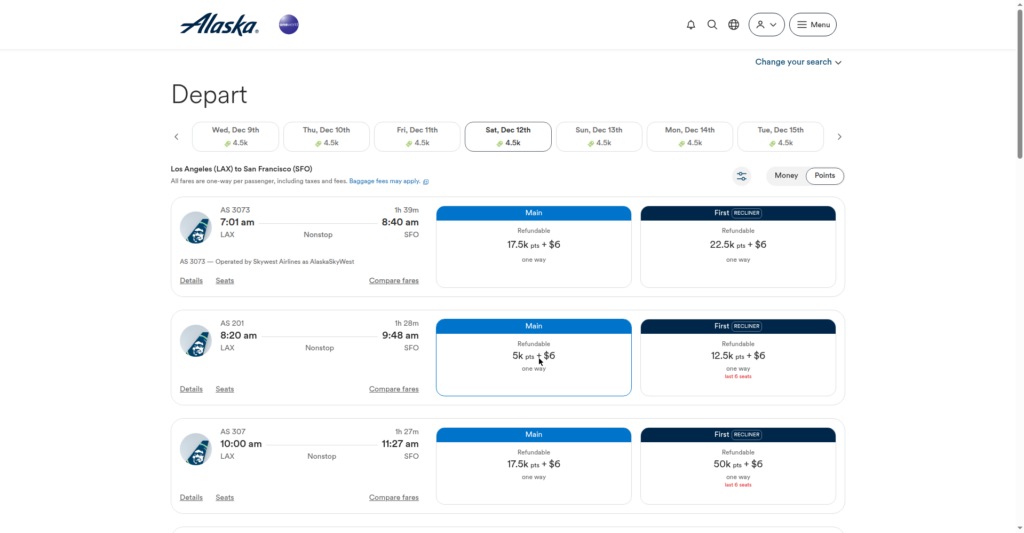
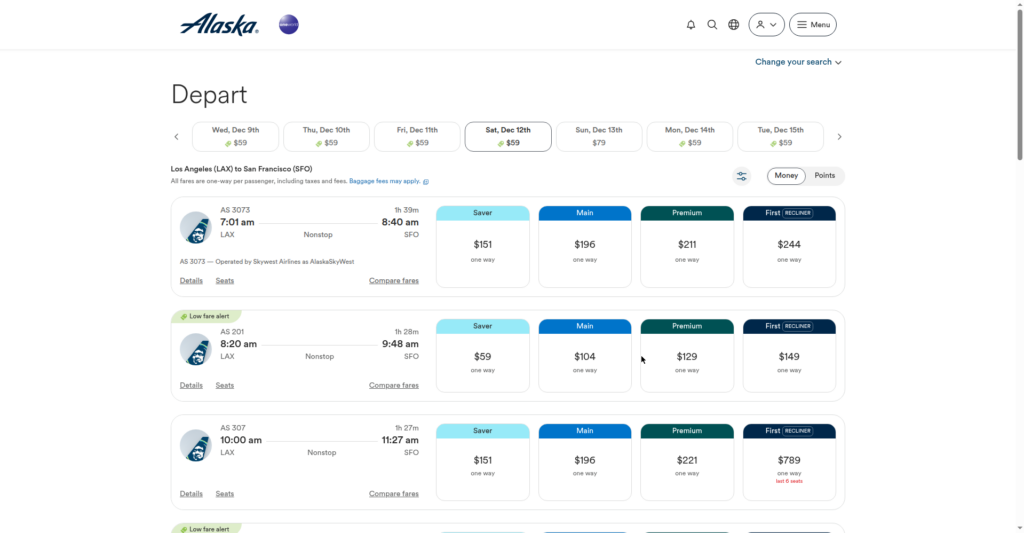
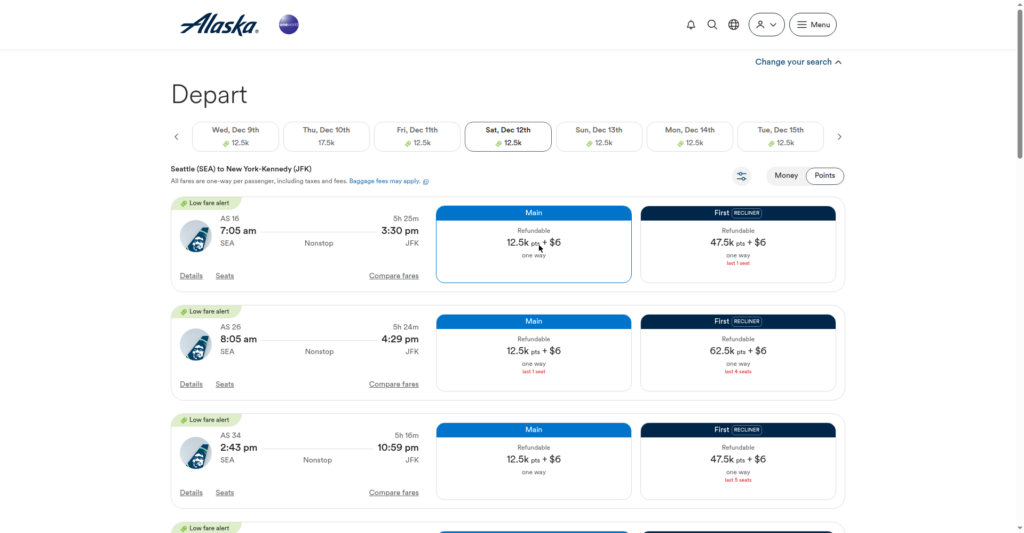
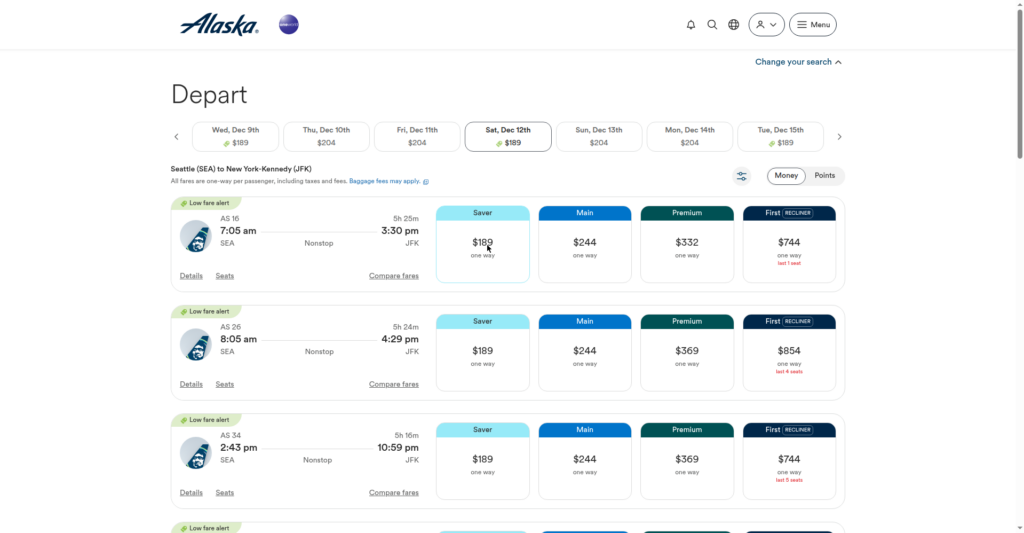
Chart prices are the ceiling of the promise. Here is what the numbers look like on actual alaskaair.com award searches, one-way for one adult, Saturday December 12, 2026. Each example compares the lowest award fare against the all-in Saver cash fare for the same flight, so the cents per point is honest.
– Los Angeles to San Francisco, AS 201 (8:20 am, nonstop): 5,000 Atmos points + $6 in taxes and fees vs $59 all-in cash. ($59 minus $6) divided by 5,000 points = 1.06 cents per point.
– Seattle to New York JFK, AS 16 (7:05 am, nonstop): 12,500 Atmos points + $6 in taxes and fees vs $189 all-in cash. ($189 minus $6) divided by 12,500 points = 1.46 cents per point.
– Seattle to Honolulu, AS 941 (6:30 pm, nonstop): 27,500 Atmos points + $6 in taxes and fees vs $454 all-in cash. ($454 minus $6) divided by 27,500 points = 1.63 cents per point.
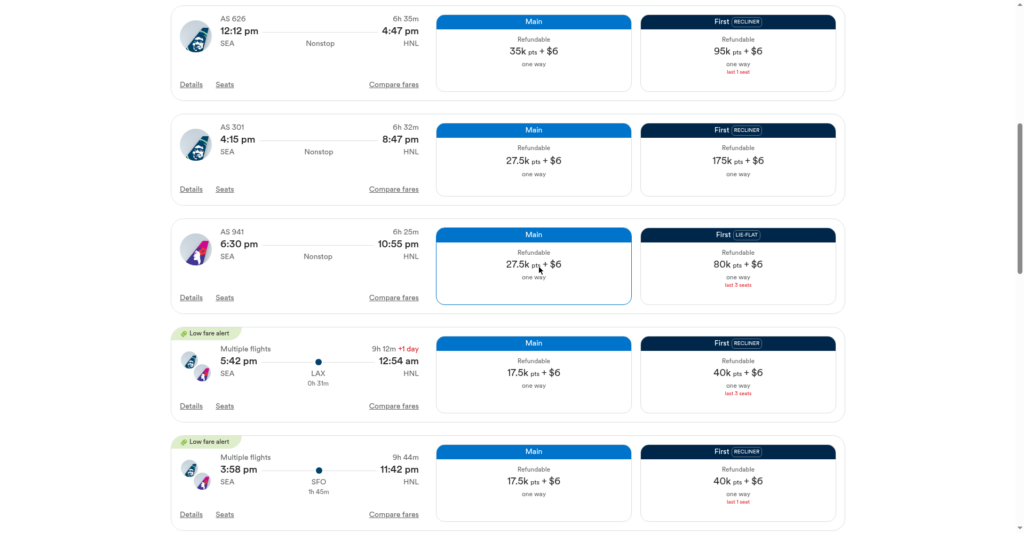
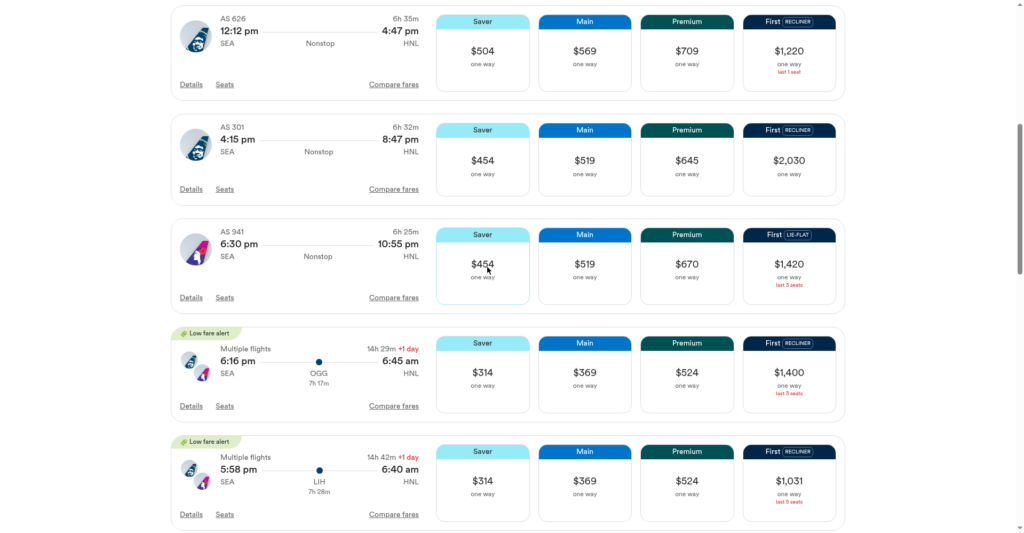
Two patterns worth noticing. Short-haul domestic awards at 5,000 points land near 1 cent per point when cash fares are cheap, which is normal. The value climbs with distance: transcon and Hawaii clear the 1.5-cent anchor, and partner business class blows past it. One honest footnote: Alaska’s current award search labels the lowest economy award fare ‘Main Refundable’ rather than ‘Saver,’ but the price points (5,000 short-haul, 12,500 transcon) are the classic saver levels.
How to earn Atmos points
Atmos is a closed ecosystem compared to the bank currencies. Two transfer partners exist today, both at fixed ratios, plus the co-branded cards. A third is on the way.
| Source | Ratio | Notes |
|---|---|---|
| Bilt Rewards | 1:1 | The best flexible source |
| Marriott Bonvoy | 3:1 | +5K per 60K transferred |
| Bank of America | TBD | Planned for 2027, ratio unannounced |
Chase, Amex, Capital One, and Citi points do not transfer to Atmos.
Earning by flying
Points can also be earned by distance, price paid, or segments flown on paid Alaska and Hawaiian flights. Note that saver fares are excluded from earning.
Bilt is the transfer that matters. One-to-one with no fees, which means a Bilt point spent on a 60K JAL business seat converts directly into 60,000 Atmos points. That is the cleanest math in the transferable-points world right now. Marriott at 3:1 is worth it only in chunks of 60,000 for the 5,000-point kicker, turning 60K Bonvoy into 25K Atmos.
The Bank of America transfers, planned for 2027, would be a big deal because the co-branded cards are BofA-issued. The eligible cards and ratio are not announced yet, so treat it as a line on the horizon, not a plan.
The co-branded cards
Two personal credit cards carry the program, both issued by Bank of America. A no-annual-fee debit card has been announced but has not launched.
Reminder: Card welcome offers change regularly, so check the current offer in the card details above before applying. Both cards include a free checked bag on Alaska flights and no foreign transaction fees.
The Ascent’s $99 Companion Fare (plus taxes and fees from $23) is the headline perk on the $95 card. The Summit’s Global Companion Award is worth up to 25,000 points and works on partner award tickets. That is the one that matters for the international sweet spots above.
A 100,000-point worked example
Put the anchor to work on real numbers. One hundred thousand Atmos points at 1.5 cents each represent roughly $1,500 in flight value. Here is what that looks like on the charts.
One option: fly Japan Airlines business class from Seattle to Tokyo, one-way, for 60,000 points. You have 40,000 points left. Use 9,000 for a round trip of American Airlines short hops (4,500 points each way, under 700 miles). That leaves 31,000 points toward your next trip.
Another option: one-way Qatar QSuites from New York to Doha for 70,000 points, with a free stopover in Doha on the way to a second destination, and 30,000 points in the bank.
The honest caveats
Every one of these numbers comes with conditions, and this is where the rankings do not tell the whole story.
“Starting at” is doing a lot of work. Partner chart prices are the starting level. You only get them when saver award space is open, and premium cabin saver space on Japan Airlines or Qatar is genuinely scarce. The chart did not get worse, but availability is the binding constraint.
Alaska’s own flights are not fixed anymore. Awards on Alaska and Hawaiian flights price variably above the starting level. The 60K JAL seat is fixed. A 12,500-point Alaska economy seat can cost more than the chart starting price on a peak day.
You cannot top up from most bank currencies. No Chase, Amex, Capital One, or Citi transfers exist. If you are short on an award, your options are Bilt, Marriott, buying points during a promo (recent ones have run around 1.75 to 1.88 cents each), or earning by flying. That closed ecosystem is also why the anchor matters less for casual earners.
There is no cash floor. Unlike bank currencies, Atmos points have no fixed cash-out value. Their worth depends entirely on finding saver award space. If you let them sit and never book a partner award, their value to you is zero, regardless of what the rankings say.
Points purchases have a ceiling on value. Buying at 1.75 cents only makes sense when the redemption beats it. At the anchor, a 60K JAL business seat bought entirely with purchased points costs about $1,050, which still undercuts the cash fare by a wide margin. Buying speculatively without a trip in mind is a losing trade.
My take
Atmos Rewards deserves the top spot. The competitive partner charts, the stopover, and the 1:1 Bilt pipeline give it a combination no other US airline program matches right now. The honest version of the verdict: the 1.5-cent anchor is real, but only if you are the kind of traveler who books international partner awards. If your redemptions are domestic economy on Alaska, your personal value sits closer to 1.2, and you should size your transfers accordingly.
Frequently asked questions
Are Atmos Rewards points the same as Alaska miles?
Yes. Atmos Rewards is the new name for Alaska’s loyalty program, launched in August 2025 as the combined program for Alaska Airlines and Hawaiian Airlines. Old Alaska miles became Atmos points at a 1:1 ratio. Anything you read about “Alaska miles” from before the rebrand is talking about the same currency.
Can I transfer Chase, Amex, Capital One, or Citi points to Alaska?
No. None of the big four bank currencies transfer to Atmos. The only flexible-point transfer partner is Bilt Rewards at 1:1, and Marriott Bonvoy transfers at 3:1 with a 5,000-point bonus per 60,000 transferred. Transfers from Bank of America card products are planned for 2027, but the eligible cards and the ratio have not been announced.
Can I really add a stopover to a one-way award?
Yes, on eligible international partner awards: one free stopover on a one-way, two on a round trip, typically up to 14 days. Book it through the multi-city search on Alaska’s site. The main exception is awards for travel wholly within Asia, where stopovers are not allowed.
Should I buy Atmos points during a promo?
Only for a specific, available award. Recent promos have priced points around 1.75 to 1.88 cents each, which beats the 1.5-cent anchor. But “beats the anchor” only matters if the booking is real. Check saver space first, buy exactly what you need, and do not stockpile.
Why are Atmos points worth more than American or United miles?
Two reasons. First, competitive partner award charts instead of dynamic pricing: the starting chart price does not move with the cash fare. Second, the free stopover on one-way partner awards, which neither American nor United offers. The 1:1 Bilt transfer pipeline is the third, quieter reason, since it lets flexible-currency earners feed the program directly.
Bottom line
Atmos Rewards points are the most valuable US airline currency for one reason: the competitive partner charts turn a predictable number of points into premium cabins that cost several thousand dollars in cash. Anchor them at 1.5 cents, earn them through Bilt, and spend them on Japan Airlines, Qatar, or Cathay Pacific business class. That is the whole game.
Related Reading:
- Alaska’s Atmos Rewards Lets You Choose How You Earn Points (2027 Guide)
- ANA and JAL Business Class to Japan: Every Way to Book With Points (2026 Guide)
- How Much Are Bilt Points Worth? (2026 Guide)
Done right, a single international business class award can deliver two to three cents per point, well above the anchor. Done wrong, the points sit unused in an ecosystem you cannot easily top up. Now you know the difference.
View comments
+ Leave a comment