

For years, Alaska was the last major US airline still paying you per mile flown. Everyone else moved to revenue-based earning a decade ago. Alaska watched, kept the distance model, and now it is handing you the menu.
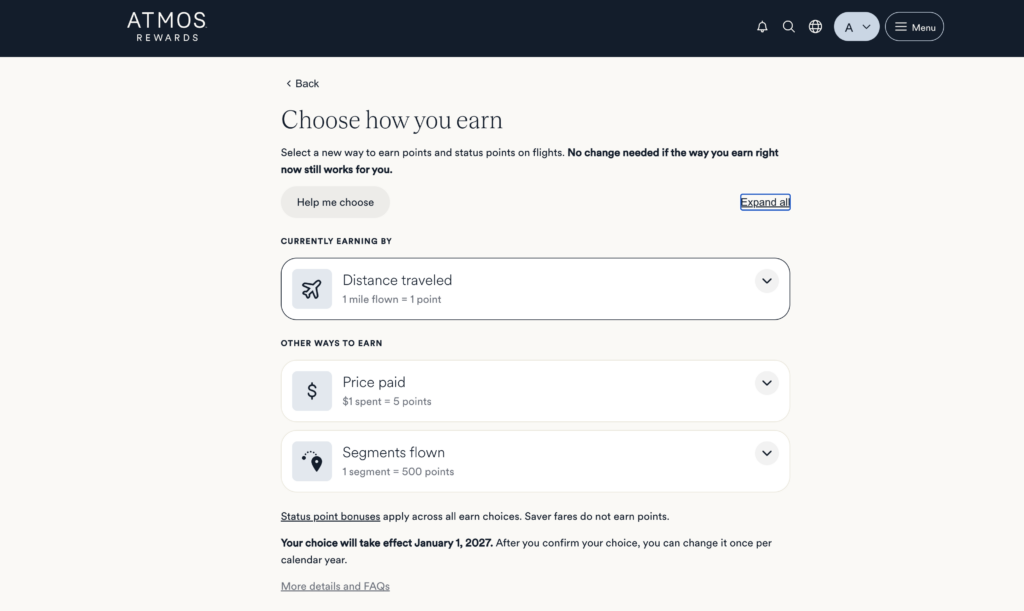
Starting October 1, 2026, Atmos Rewards members can choose how they earn points on flights: by distance traveled, by price paid, or by segments flown. The choice takes effect for flights departing on or after January 1, 2027. This is the program change Alaska first promised when Atmos Rewards launched in August 2025, and the selection window is open right now.
Here is what changed, the exact rates for each option, the breakeven math that picks your winner, and the one default you need to avoid. This is a two-minute decision that shapes your 2027 earning, so it is worth getting right the first time.
TL;DR
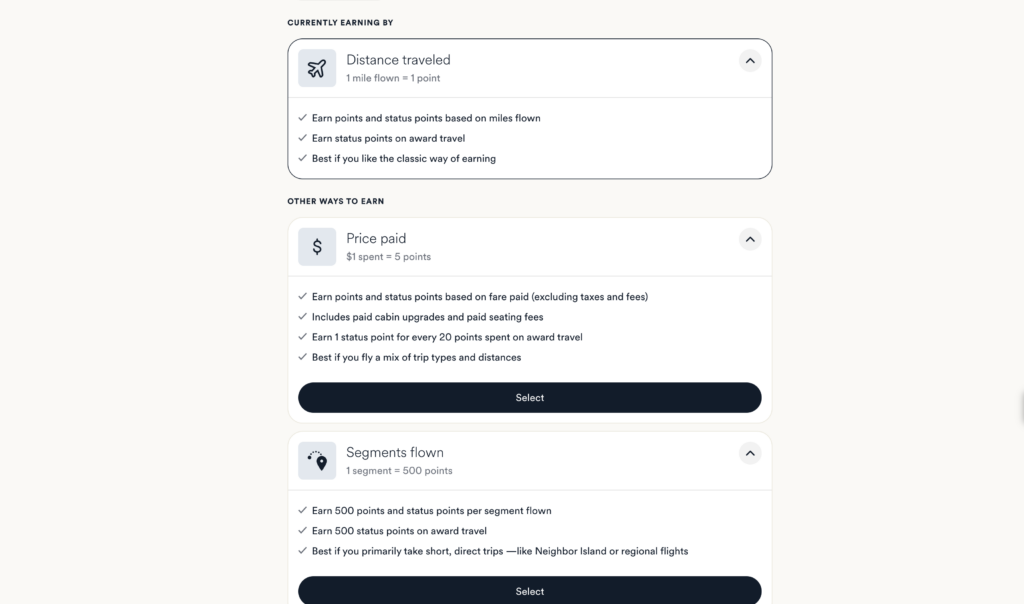
- Three earning options, effective for flights departing on or after January 1, 2027: 1 point per mile flown, 5 points per $1 of eligible airfare, or 500 points per segment.
- Your pick applies to both redeemable points and status points, so it shapes elite qualification too.
- You can change your choice once per calendar year; changes apply to future travel only.
- Existing members who do nothing stay on distance. New members joining on or after January 1, 2027 default to price paid. Atmos will also recommend an option based on your travel profile.
| Method | Earning rate | Best for |
|---|---|---|
| Distance traveled | 1 point per mile flown | Cheap economy fares, long-haul flyers |
| Price paid | 5 points per $1 of eligible airfare | Expensive or premium-cabin tickets |
| Segments flown | 500 points per segment | Frequent short hops (Hawaii inter-island, LA-SF) |
Atmos Rewards earning options. Selection opens October 1, 2026; rates apply to flights departing on or after January 1, 2027. Price-paid excludes taxes and fees.
What actually changed
Atmos Rewards is the loyalty program shared by Alaska Airlines and Hawaiian Airlines. When it launched in August 2025, Alaska promised members would eventually pick their own earning model. That promise now has dates: selection opens October 1, 2026, and the method you pick applies to flights departing on or after January 1, 2027.
A few mechanics, all from Alaska’s official announcement:
- Both point types. Your choice covers redeemable points and status points, the ones that determine elite qualification. That setting moves your elite progress directly.
- Once a year. You can change your earning choice once per calendar year, and changes apply to future travel. If your travel patterns shift, you can adapt, but you cannot re-pick for trips already flown.
- Choosing is optional. Current members who never select anything keep earning by distance, exactly as today. New members joining on or after January 1, 2027 default to price paid.
- Atmos will nudge you. The program plans to recommend an option based on your travel profile, which is a nice assist but no substitute for the math below.
Either way, the math is what matters: Alaska and Hawaiian are the last major US airlines paying per mile flown, and instead of copying the revenue model wholesale, Alaska is letting each member choose the version that pays them best.
The three earning methods, explained
Distance traveled
1 point per mile flown. This is how Atmos works today, and it stays the fallback if you do nothing.
It favors long flights on cheap fares. A 2,400-mile transcontinental ticket earns 2,400 points whether you paid $189 or $489. The catch is symmetrical: a $600 fare on a 900-mile flight earns just 900 points.
Price paid
5 points per $1 spent on eligible airfare and paid upgrades to premium cabins, excluding taxes and fees. Per reporting on the program terms, award flights also earn at 1 point per 20 points redeemed.
It favors expensive tickets. Premium-cabin buyers, business travelers on flexible fares, and anyone paying last-minute prices come out ahead here. But on a sale fare, revenue-based earning is punishing, which is exactly why the distance option matters.
Segments flown
A flat 500 points per segment, on paid or award tickets alike.
It favors short hops. Hawaii inter-island flights, LA to San Francisco, Seattle to Portland: the kind of flying where the miles are tiny but the segments stack up. One honest note: on a single nonstop cross-country flight, 500 points is a terrible deal. Segments only make sense when you fly a lot of short ones.
The 20-cent rule: the breakeven math
Here is the decision in one rule. Price-paid earning (5 points per dollar) beats distance earning (1 point per mile) when:
5 x fare > miles, which means fare > miles / 5.
In plain English: if your fare is more than 20 cents per mile flown, price wins. Under 20 cents per mile, distance wins. Meanwhile, segments beat distance on any flight under 500 miles (500 flat vs. 1 per mile), and segments beat price whenever 500 exceeds 5x your fare, meaning fares under $100.
Run three travelers through it:
| Traveler | Distance | Price | Segments | Winner |
|---|---|---|---|---|
| JFK-SEA, ~2,400 mi, $189 fare | 2,400 | 945 | 500 | Distance |
| SEA-LAX, ~950 mi, $600 premium fare | 950 | 3,000 | 500 | Price |
| 4 Hawaii inter-island hops, ~100 mi each, $60 each | 400 | 1,200 | 2,000 | Segments |
Illustrative math on one-way examples. Price method uses fare before taxes and fees; exact flight miles vary by route. Winners marked in blue.
Each method has a home. The cheap long-haul fare belongs to distance. The expensive premium ticket belongs to price. The pile of short hops belongs to segments. If your travel is a mix, pick the method that covers most of your 2027 flying, since you only get to change once a year.

The honest caveats
The 2027-joiner default is a trap for the wrong traveler. If you join Atmos on or after January 1, 2027, you default to price paid. For a deal-hunter booking cheap long-haul economy, that default can quietly cost thousands of points a year versus distance. New members should check the setting before their first 2027 flight. Existing members are fine doing nothing.
You only get one switch a year, so choose for the year ahead. The change applies to future travel, and you cannot undo it mid-year if your plans change. Think about what your 2027 travel actually looks like, not the trip you booked last week.
Partner flights are unconfirmed. Alaska has not said whether your chosen method applies to partner airline flights or whether a separate scheme covers them. If you earn a big share of your points on oneworld partners, I would wait for the program terms to spell this out before committing.
Award tickets earn differently. On the price method, award flights reportedly earn 1 point per 20 points redeemed, a slow drip. On the segments method, each award segment still earns the flat 500. If you fly mostly on award tickets, segments can beat price by a wide margin on short hops.
Status points move with your choice. This matters more than it looks. If you are chasing Atmos elite status, the method that maximizes your redeemable points also moves the status needle in the same direction. Run the math once, and it counts twice.
My take
Most leisure travelers booking economy should stay on distance. It is the default for a reason: cheap fares and long flights are exactly what distance-based earning rewards, and most sale fares sit well under 20 cents a mile.
Switch to price if you regularly buy premium cabins or expensive flexible fares. Your per-mile fare clears 20 cents easily, and the 5x multiplier does the heavy lifting.
Pick segments if your life is short hops: inter-island Hawaii flying, the LA-SF corridor, Seattle-Portland. Four hundred miles a year of that flying earns 400 points on distance and 2,000 on segments. That is not a close call.
One caveat I keep coming back to: the once-a-year lock means your pick should match your dominant pattern, not your next trip. The traveler who flies cheap transcons in January and business class in November still has to pick one. When in doubt, distance is the safest default in this program, which is probably why Alaska made it the default for existing members.
Frequently Asked Questions
Do I have to make a choice at all?
No. Choosing is optional. Existing Atmos Rewards members who never select a method keep earning by distance, exactly as they do today. Only new members joining on or after January 1, 2027 need to pay attention, since they default to price paid.
When does my earning choice take effect?
You can select your method starting October 1, 2026. It applies to flights departing on or after January 1, 2027, for both redeemable points and status points.
Can I change my mind later?
Yes. You can change your earning method once per calendar year, and the change applies to future travel. So review your pick each year against the travel you actually expect, not the travel you wish you were taking.
Does the choice affect elite status?
Yes. Your selected method determines how you earn status points too, not just redeemable points. Pick the method that maximizes your typical trip and it pulls double duty toward status.
Will this apply to partner airline flights?
Unconfirmed. Alaska has not spelled out whether the chosen method covers partner flights or whether a separate earning scheme applies. If partners drive a large share of your earning, wait for the full program terms before switching away from distance.
What about the Bank of America point transfers?
Alaska confirmed that eligible Bank of America card products will be able to transfer points into Atmos Rewards sometime in 2027. No cards were named, no ratio was given, and no date was set. Treat it as confirmed-but-undefined until Alaska publishes the details.
The Bottom Line
Alaska is the only major US airline program letting members pick their earning model, and the math makes the decision straightforward. Under 20 cents a mile, stay on distance. Over it, take price. Flying lots of short hops, take segments. Existing members are safe doing nothing; new 2027 joiners should check the default before their first flight.
Related Reading: How to Transfer Credit Card Points to Airlines: The Beginner’s Guide | Airline Alliances Explained: Maximize Your Points
Pick the method that matches your 2027, not your last trip.
View comments
+ Leave a comment