The Atmos™ Rewards Ascent Visa Signature® credit card is offering 70,000 bonus points, plus a $99 Companion Fare (plus taxes and fees from $23).
The short version: spend $2,500 on the card in the first 90 days and you earn 70,000 bonus points and the Companion Fare. One spending target, one bonus, nothing to miscount. The reason to move on it is the currency. Atmos points are some of the most valuable points you can collect, in my opinion, and I plan around 1.5 cents each. At that rate, the bonus is worth about $1,050 in flights before you earn a single point from spending.
Here is the offer in plain terms, what the card earns day to day, how the Companion Fare works in practice, and three real redemptions I pulled from alaskaair.com today, screenshots included, so you can see what 70,000 points actually buy.
TL;DR
- 70,000 bonus points after $2,500 in purchases in the first 90 days.
- A $99 Companion Fare (plus taxes and fees from $23) comes with the welcome offer.
- Earning: 3 points per dollar on eligible Alaska Airlines and Hawaiian Airlines purchases, 2 points per dollar on gas, EV charging, cable, streaming and local transit including rideshare, 1 point per dollar on everything else.
- Free checked bag and preferred boarding for you and up to 6 guests traveling on the same reservation when you purchase Alaska Airlines or Hawaiian Airlines airfare with your card, and a 10% bonus on points earned from purchases if you hold an eligible Bank of America or Merrill account.
- I value Atmos points at 1.5 cents each, so the bonus is worth about $1,050 in flights at my planning rate.
The offer, in plain terms
This welcome offer has one spending target. Spend $2,500 in purchases within 90 days of opening the account and you earn 70,000 bonus points and the Companion Fare code. There is no second tier to miscount, and no extra spending needed beyond the one target.
| Step | Spending | You earn | Running total |
|---|---|---|---|
| Welcome offer | $2,500 in 90 days | 70,000 points + Companion Fare | 70,000 points |
The 70,000-point offer, November 19, 2026.
What the card earns, and the benefits that matter
The everyday earning is simple, with no caps on the bonus categories:
| Spending | Points per $1 |
|---|---|
| Eligible Alaska Airlines and Hawaiian Airlines purchases | 3 points |
| Gas, EV charging, cable, streaming, local transit including rideshare | 2 points |
| Everything else | 1 point |
Earning rates on the Atmos Rewards Ascent Visa Signature credit card. Hold an eligible Bank of America or Merrill account and points earned from purchases get a 10% bonus on top.
The benefit I use most is the checked bag. The first checked bag is free for you and up to six guests on the same reservation, on Alaska and Hawaiian flights, when the flight is paid for with the card. Pay for the same flight with a different card and the benefit does not apply, which is the mistake people make in year two. Preferred boarding comes with it.
If you hold an eligible Bank of America checking or savings account, or a Merrill account, every purchase earns 10% more points. The 3 points per dollar on Alaska and Hawaiian purchases becomes 3.3, and it applies across everything the card earns from spending.
The Companion Fare, properly explained
The Companion Fare is a discount code that Alaska deposits into your Atmos Rewards account. At booking, the code cuts the second traveler’s base fare to $99, plus taxes and fees from $23, so the second seat costs from $122 in total. The first traveler pays the regular fare. Both travelers have to be on the same reservation, booked at the same time, and both earn Atmos points on the flight, because these are paid tickets, not awards.
That last point is what makes this benefit different from most companion certificates. The companion is a regular paying passenger at a $99 base fare. The tickets can be upgraded like any other paid booking.
How to use the code
- Earn it. The welcome offer ($2,500 in purchases in 90 days) includes the code. It posts to your Atmos account within the first two billing cycles after you qualify.
- Find it. Sign in at alaskaair.com and open the discount and companion fare codes section of your account. The code sits there with its own expiration date.
- Start the search with the code. Search for two travelers and enter the code in the discount code field before you search, or use the booking button next to the code in your account.
- Pick eligible flights. Saver or Main Cabin, one-way or round-trip, on flights operated by Alaska Airlines or Hawaiian Airlines within North America, Hawaii included.
- Pay with the Ascent card. The whole booking has to go on the primary cardholder’s Ascent card. The purchase will not complete on another card.
The math
The saving is whatever the second ticket would have cost, minus $122 at the floor. Run an example at a $400 second fare, a normal price for a longer Alaska route at a busy time:
| Item | Amount |
|---|---|
| Second traveler’s ticket at the regular fare (example) | $400.00 |
| Same seat with the Companion Fare: $99 fare plus taxes and fees from $23 | from $122.00 |
| Saved on this one booking | $278.00 |
A cheap short hop wastes it, because the saving shrinks with the fare. Save the code for the most expensive economy ticket you book together that year.
The rules and the catches
- Economy only. Saver or Main Cabin fares. The code does not work on First Class, and it does not work on award tickets. It is a discount on paid fares only.
- Alaska and Hawaiian metal only. Flights operated by Alaska Airlines or Hawaiian Airlines within North America, Hawaii included. Partner and oneworld flights are out, even if Alaska sells them.
- You do not have to be one of the travelers. You can book the two seats for two other people. The one hard rule is payment: the booking must be charged to your Ascent card.
- Book within 12 months of issue. The trip itself can fall after the code’s expiration date. What matters is that the ticket is bought in time.
- It comes back every year, with a condition. Spend $6,000 or more on the card in an anniversary year and a new code posts the following year, within two billing cycles after your anniversary. Come in under $6,000 and there is no code that year. The welcome offer’s code has no such condition; it arrives with the welcome offer.
Why Atmos points are worth collecting
I plan around 1.5 cents per Atmos point, and the redemption examples below are why. Partner business class prices at levels that would cost far more in cash, short domestic hops start at 4,500 points, and the cash fees on most partner awards are low. At that planning value, the 70,000-point bonus is about $1,050 in flights.
The network does a lot of the work. Atmos Rewards is the shared program of Alaska Airlines and Hawaiian Airlines, and Alaska belongs to oneworld, so the same points book American Airlines, Japan Airlines, Cathay Pacific, Qantas and the rest of the alliance. The partner list runs past the alliance as well: Philippine Airlines, Condor, Aer Lingus, Icelandair and Korean Air are all bookable with Atmos points.
Then there is the stopover rule, the one I use most. One enroute stopover of up to 14 days is allowed on an eligible international one-way award, and an international round trip allows two, one in each direction. Booked as a multi-city itinerary, the trip prices as a single award, so a flight to Asia can carry a long stop in a partner hub city on the way.
Getting more points is the constrained part, and it is the practical reason this offer matters. Almost no bank currency transfers into Atmos. Bilt Rewards transfers at 1:1, and Marriott Bonvoy transfers at 3:1 with a 5,000-point bonus for every 60,000 points moved. Chase, Amex, Citi and Capital One points do not transfer in at all. Alaska has announced that eligible Bank of America cards will be able to transfer points into Atmos sometime in 2027, with the cards and the ratio still unpublished. Until then, the co-branded cards and flying are how a balance gets built. Atmos points do not expire, though Alaska can lock an account that sits untouched for two years until you call to verify your identity.
What 70,000 points actually buy: three real searches
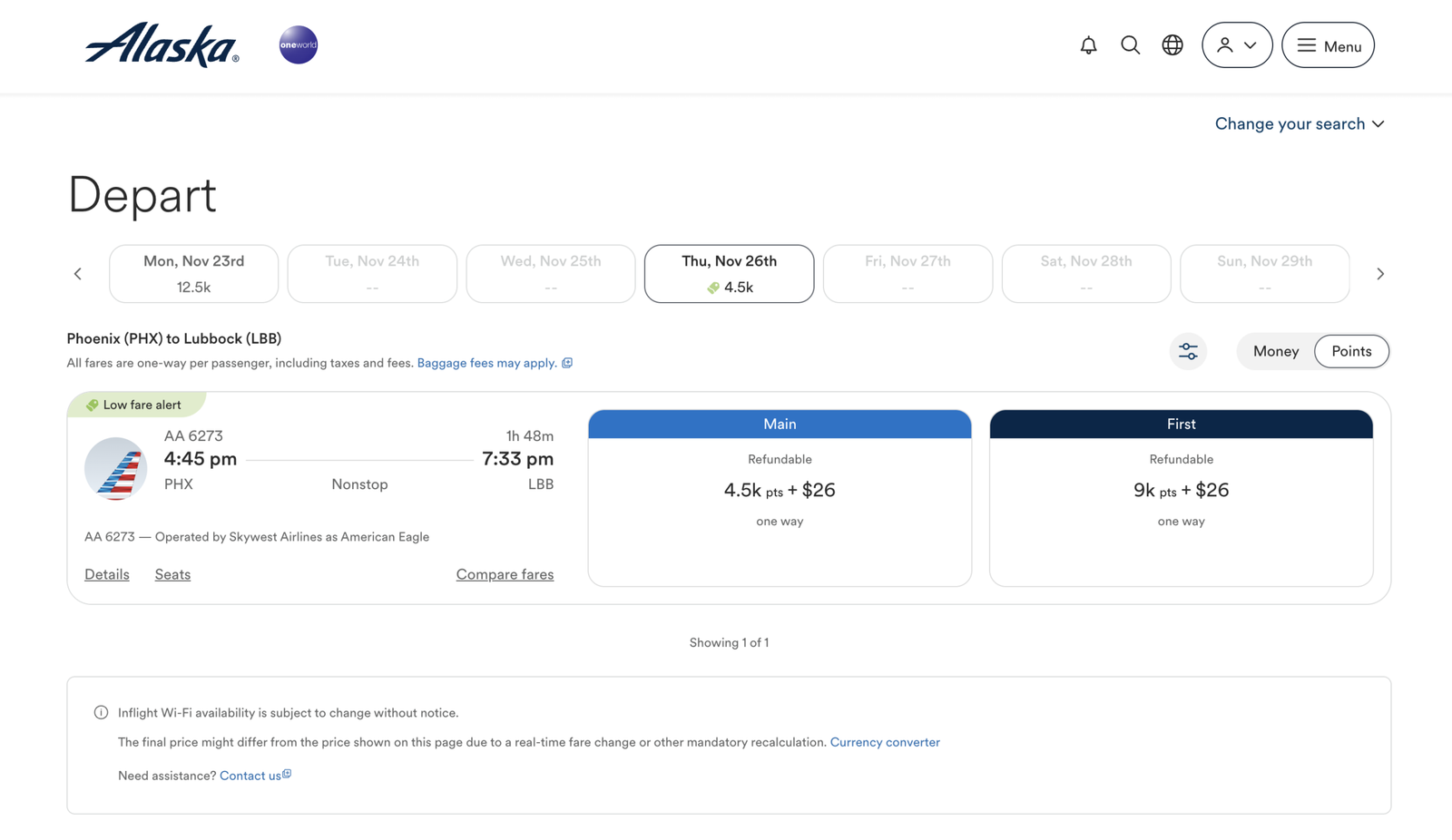
I ran these searches on alaskaair.com today, November 13, 2026. Prices are one-way, per person, and the cash column in each screenshot is taxes and fees. Award space moves, so read these as what the program charges when the seats exist.
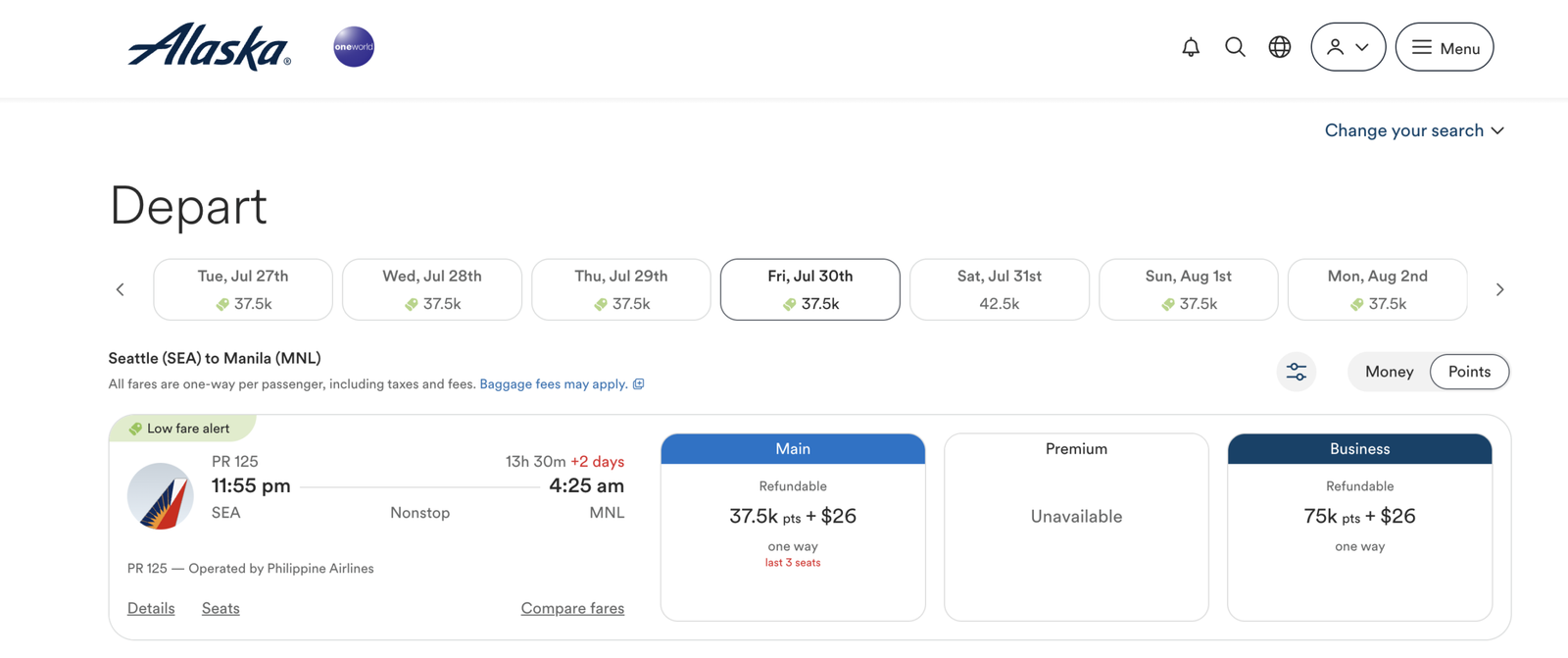
Seattle to Manila in business class: 75,000 points
Philippine Airlines flies Seattle to Manila nonstop, and Atmos sells the seat. On Friday, July 30, 2027, flight PR 125 leaves Seattle at 11:55 pm and arrives in Manila at 4:25 am, two days later. Business class costs 75,000 points plus $26 in taxes and fees. Main Cabin is 37,500 points plus $26, and the calendar strip across the top shows that 37,500 price on six of the seven days that week, so the availability is a pattern, not a one-off. The search showed the last 3 seats in Main Cabin that day.
The welcome bonus covers the business seat almost outright: 70,000 of the 75,000 points, with the small gap easy to close from everyday spending. At my 1.5-cent planning value, that seat is worth about $1,125 in flight value.
Philadelphia to Lisbon in business class: 45,000 points
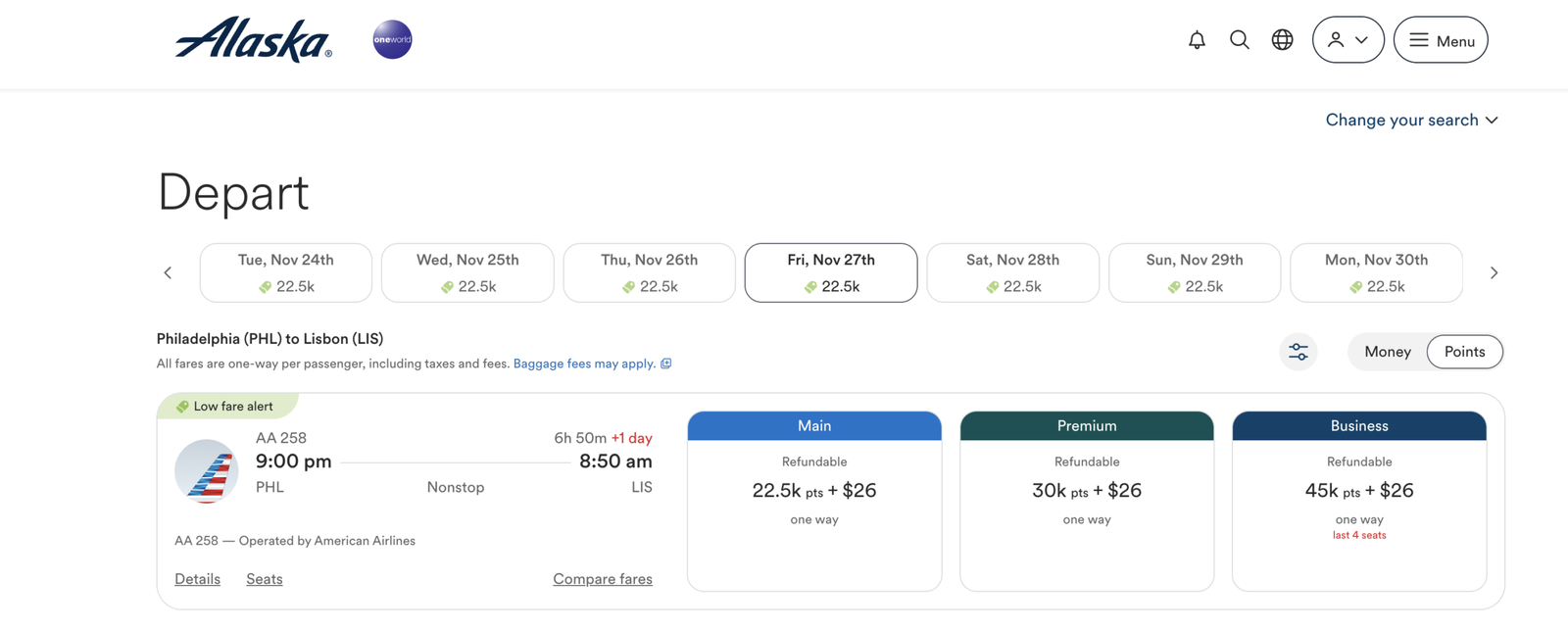
American Airlines flies Philadelphia to Lisbon nonstop, and at this price it is one of the cheapest lie-flat crossings of the Atlantic in any program. On Friday, November 27, 2026, flight AA 258 leaves at 9:00 pm and arrives in Lisbon at 8:50 am the next morning. Business class is 45,000 points plus $26, and the search showed the last 4 seats. Main Cabin is 22,500 points plus $26, and the calendar shows 22,500 on every day that week, Thanksgiving Day included.
Against the bonus, the math is generous: 45,000 points for the business seat leaves 25,000, which covers the same flight in Main Cabin at 22,500 with 2,500 points still in the account.
Phoenix to Lubbock on Thanksgiving Day: 4,500 points
Not every redemption needs to cross an ocean. On Thanksgiving Day, Thursday, November 26, 2026, American Eagle’s nonstop from Phoenix to Lubbock, flight AA 6273, costs 4,500 points plus $26 in Main Cabin, or 9,000 points in First. It is the only flight on the route that day. Short hops at 4,500 points are the floor of the program’s partner pricing, and they are how a balance gets spent on the ordinary trips you take every year, on the days when cash fares spike.
The bonus would cover fifteen of these one-way hops. Read the other way, 70,000 points is a year of small flights taken care of.
The honest caveats
The spending target is the whole game. The bonus needs $2,500 of spending in 90 days, roughly $833 a month, which is ordinary spending for most households. Do not manufacture spending to chase points; interest and fees eat the value faster than the points add it.
Award space is the real constraint. Partner airlines control the seats, and the screenshots show the reality: last 3 seats here, last 4 seats there. These prices are real when seats exist. Finding them on your exact dates takes flexibility, and some partners release very little space at all.
Partner awards carry a fee. Itineraries that include a partner flight carry a $20 booking fee per person, each way, and it is not refundable if you cancel. The $26 in the screenshots is the combined taxes and fees on those searches.
The 1.5-cent figure is a planning value. It is what I use to compare options, not a cash price. Atmos points have no cash-out route worth using, so points you cannot fly are worth nothing.
My take
If you fly Alaska or Hawaiian even a couple of times a year, or you have one international trip you want to take in business class, this is the version of the Ascent offer to take. At $2,500 of ordinary spending in 90 days, 70,000 points plus a Companion Fare is lopsided value, and the single spending target makes it simpler than the split structure this card ran before.
Frequently Asked Questions
How much do I have to spend to get the 70,000 points?
Spend $2,500 in purchases within the first 90 days and you earn 70,000 bonus points plus the $99 Companion Fare (plus taxes and fees from $23). There is one spending target, so there is no second tier to track.
Do I have to be one of the travelers to use the Companion Fare?
No. You can book the two seats for two other people. The conditions are that both travelers are on the same reservation, the flights are Saver or Main Cabin on Alaska or Hawaiian within North America, and the whole booking is paid for with your Ascent card.
Does the Companion Fare come back every year?
Yes, if the card gets used. Spend $6,000 or more in an anniversary year and a new code posts to your Atmos account within two billing cycles after your next anniversary. Spend less than $6,000 and no code is issued that year. The code from the welcome offer carries no spending condition beyond the $2,500 welcome target.
Which points transfer into Atmos Rewards?
Bilt Rewards transfers at 1:1. Marriott Bonvoy transfers at 3:1, with a 5,000-point bonus for every 60,000 points transferred. Chase, Amex, Citi and Capital One points do not transfer to Atmos. Alaska has announced Bank of America point transfers for 2027, with the eligible cards and the ratio still to be published.
Bottom Line
70,000 Atmos points and a $99 Companion Fare (plus taxes and fees from $23). At 1.5 cents a point, the bonus is worth about $1,050 in flights, and the screenshots above show the shape of it: Lisbon in business for 45,000, most of a business class seat to Manila at 75,000, a Thanksgiving Day hop for 4,500. If $2,500 in 90 days is normal spending for you, this is an easy yes, with no stretch spending required.
Related Reading: How Much Are Alaska Atmos Rewards Points Worth? (2026 Guide) · The Best Ways to Spend Alaska Atmos Rewards Points (2026 Guide) · How to Transfer Credit Card Points to Airlines: The Beginner's Guide (2026 Guide) · Do Airline Miles Expire? The 2026 Guide to Every Expiry Rule