
The Chase Sapphire Reserve hands you $500 a year in luxury hotel credits, free breakfast for two, and a $100 credit to spend at the hotel on every single stay.
The Edit is only one of the Reserve’s hotel credits. I broke down the full $1,000-plus hotel credit stack on the Reserve separately.
Here is the strange part. On January 1, three separate changes make this card more valuable, and not one of them is Chase improving the card itself. Everyone around it is getting worse, and the Reserve is standing still.
This post is the written version of my YouTube video on The Edit credits. Tap the image above to watch it, or read on. Below is everything in the video: how The Edit works, four ways to stack its credits so one trip can pull $500 or more out of this card, and why January 1 is the day the Reserve quietly pulls ahead of the Amex Platinum.
I have already compared The Edit against Amex Fine Hotels and Resorts head to head. This post is different: it is about squeezing the most out of The Edit itself.
What The Edit is
The Edit is Chase Travel’s collection of luxury hotels, and it is Chase’s answer to Amex Fine Hotels and Resorts. The collection has about 1,500 hotels around the world.
Access is limited to Reserve cardholders: the Sapphire Reserve, the Sapphire Reserve for Business, and the J.P. Morgan Reserve. If you only hold a Sapphire Preferred, you cannot use it, and that exclusivity is part of why the perks are as strong as they are.
Every stay booked through The Edit comes with the same package of perks:
- Daily breakfast for two, which at a luxury hotel is easily $100 a day on its own
- A $100 property credit to spend at the hotel during your stay, on dining, the spa, or activities. It does not come off the room rate itself
- A room upgrade when one is available
- Early check-in and late checkout when the hotel can offer them
- A welcome amenity when you arrive, and complimentary Wi-Fi
None of that requires hotel elite status, and none of it depends on which hotel chain it is. The perks come from the booking, not from a loyalty program.
The collection is about to get much bigger, too. From January 1, 2027, The Edit is adding more than 10,000 curated vacation homes, with their own perks, including a $150 credit to spend during your stay. Your Edit statement credits work on those bookings too, although a home stay needs at least four nights to unlock the perks.
The $500 in credits, and the rules that matter
The Sapphire Reserve gives you two statement credits of $250 each per calendar year, up to $500 total, for stays booked through The Edit.
Each credit applies to a prepaid booking of two nights or more, and each booking can only use one credit.
One clarification, because this trips people up. Prepaid does not mean non-refundable. It simply means your card is charged when you book, rather than when you check in. Whether you can cancel depends on the rate you pick, and plenty of these prepaid rates are refundable, so always read the cancellation terms before you pay.
Since the start of 2026, Chase no longer splits the credits into halves of the year, so you can use both whenever you want during the year. Whatever you do not use expires at the end of the year, and the purchase that earns the credit does not itself earn points.
The way most people use this benefit is to book one nice stay, take one $250 credit, and leave the rest of the value on the table. There are four stacks instead, and they build on each other.
Stack 1: Split the stay, use both credits on one trip
A single booking can only take one $250 credit, but nothing stops you from making two separate bookings.
Instead of booking a four-night trip as one reservation, book it as two back-to-back stays of two nights each. Each booking qualifies on its own and takes its own $250 credit, which means you have pulled the full $500 out of the card on a single trip.
Because the perks attach to the stay rather than the trip, the second booking should come with its own $100 property credit as well. Some properties treat back-to-back bookings as a single stay and will only honor one property credit, so your mileage may vary on that piece.
You may also need to stop by the front desk in the middle of the trip to check out and check back in. Hotels handle back-to-back reservations every day, and you will usually keep the same room.
Stack 2: Points Boost and the split payment
Stays booked through The Edit with Chase points still come with the full package of perks, the breakfast, the $100 credit, all of it.
On top of that, Chase runs Points Boost, where your points are worth more than the usual rate at select hotels, up to two and a half cents each at a small set of properties. That set changes every month.
The trick is the split payment. A booking paid entirely in points gets no Edit credit. Put at least $250 of the booking on the card, and the credit still fires. Here is what that looked like on two trips I actually booked this year.
Earlier this year I booked three nights at the Ritz-Carlton in Turtle Bay, in Hawaii, through The Edit. The stay cost $3,446 all in. A $500 travel credit on my account from the welcome offer came off first. Then I paid with 133,000 Chase points, and because of Points Boost those points were worth two cents each, covering $2,660 of the stay. I put the remaining $286 on the card, on purpose, because that is what triggers the $250 Edit credit.
That Turtle Bay stay has its own full breakdown, including how the three nights came to $36 out of pocket.
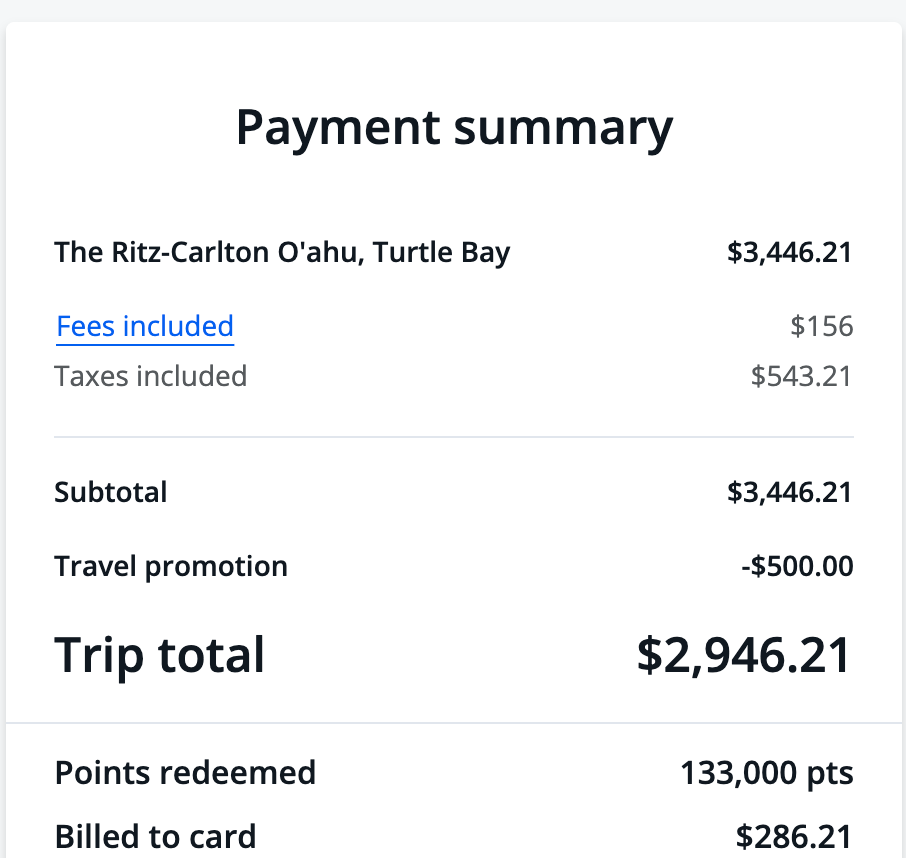
Here is the comparison that made me book it this way. Those same three nights, booked with Marriott points instead, were pricing at over 300,000 points. I booked the same stay for 133,000 Chase points, less than half, and still got the full Edit treatment: free breakfast every morning, a room upgrade, and the $100 property credit, which I put toward a night snorkeling experience at the resort.
Do not underestimate the breakfast, either. At hotels like these, breakfast runs about $50 to $60 per person, so for two people over three mornings, that is over $300 of breakfast that cost me nothing.
The second booking is smaller, and it shows the same play on a normal trip. Two nights at the Fairmont Chateau Whistler came to $999 all in. I put 30,000 points toward it and $504 on the card, and the $250 Edit credit came back to me, so my real out of pocket was about $254, plus the points, for two nights at a Fairmont in the middle of summer, with breakfast included.
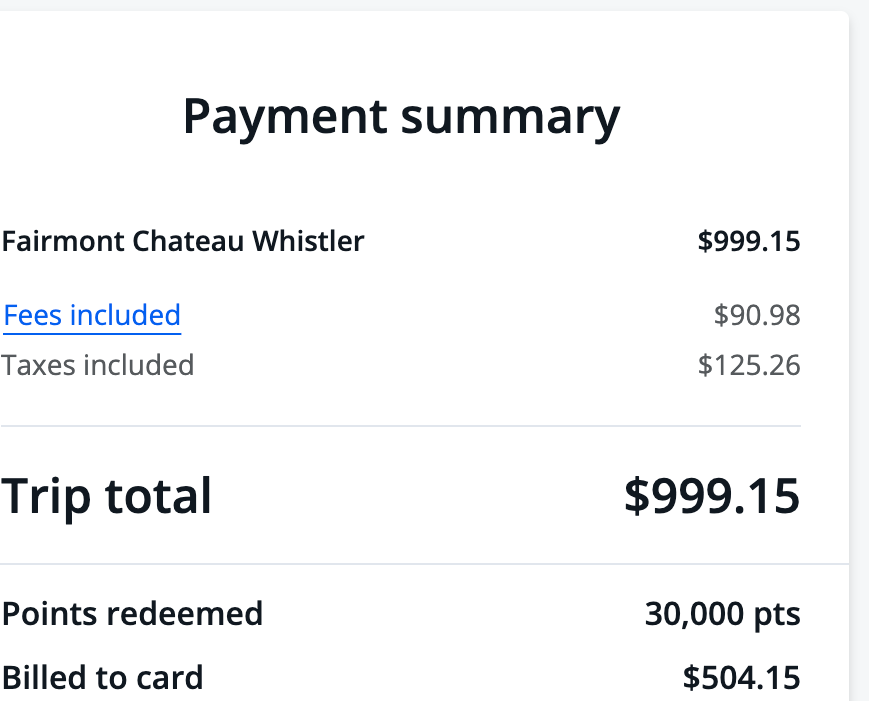
One more layer from that same trip. We booked two rooms at Whistler, because we were traveling as a group of six. I hold both the Sapphire Reserve and the Sapphire Reserve for Business, and each card carries its own set of Edit credits, so I booked one room on each card with the exact same points and cash split. Each booking earned its own $250 Edit credit, and each room came with its own $100 property credit. That gave us $200 in property credits, which went toward one big dinner at the hotel restaurant.
Stack 3: The extra $250 hiding in 2026
For 2026, Chase added a one-time extra $250 credit for prepaid stays of two nights or more at seven hotel groups: IHG, Montage, Pendry, Omni, Virgin Hotels, Minor Hotels, which includes brands like Anantara, and Pan Pacific.
Some hotels are in both programs at once, an Edit property that is also one of those brands. Book one of those and both credits land on the same stay, which means $500 comes off a single two-night booking, on top of the breakfast and the $100 property credit.
This extra credit is confirmed through December 31, 2026, and whether Chase brings it back for 2027 is an open question. If you have a luxury hotel stay planned before the end of this year, this is the first place I would look.
Stack 4: Split one trip across The Edit and FHR
The fourth stack is for those of you who carry both premium cards, and it splits one trip across two programs.
Take a four-night trip and book the first two nights through The Edit on your Sapphire Reserve, and the last two nights through Amex Fine Hotels and Resorts on your Platinum. The Edit nights take a $250 credit, and the FHR nights take the Platinum’s $300 lodging credit.
Each stay carries its own $100 property credit, so that is another $200 to spend at the hotel. And you get breakfast for two every single morning of the trip, because both programs include it on every stay.
One trip, two programs, $550 in card credits, $200 in property credits, and breakfast every day. That is what stacking actually looks like when you put the two cards together instead of choosing between them.
January 1: why the Reserve wins by standing still
The Reserve is not getting better because Chase keeps improving it. It is getting better because everyone around it keeps getting worse, and January 1, 2027 is the day three of those changes land at once.
The first is Hyatt. Transferring points to Hyatt remains one of the best deals in this entire hobby, because Hyatt still prices its awards on a chart. Bilt has been one of the best ways into Hyatt at one to one. On January 1, Bilt drops that transfer to four to three, which means 1,000 Bilt points become 750 Hyatt points. The Sapphire Preferred already made that same drop back in October, and so did the Ink Business Preferred.
So from January, the two Reserve cards are the only major cards that still move points into Hyatt at the full one to one rate. Chase did not improve the Reserve’s Hyatt transfer. Everyone else’s got worse, and for the person choosing which premium card to hold, that lands exactly the same way.
The second change is the one that used to be The Edit’s biggest weakness. The Edit credit has always required a two-night stay, and Amex Fine Hotels and Resorts did not, so you could burn the Platinum’s credit on a single night. That advantage is ending. From January 1, 2027, Amex is putting a two-night minimum on the FHR credit as well. If you have a one-night FHR stay you want to book with the Platinum’s credit, you have until the end of 2026.
The third change is the business card. On January 1, 2027, the Sapphire Reserve for Business Edit credit doubles, from $500 a year to $1,000 a year, four $250 credits instead of two, on exactly the same rules. The personal Sapphire Reserve does not get this increase. It stays at $500.
Let me keep this honest, because the Platinum still wins a few rounds. Its credits are $300 each instead of $250, and Fine Hotels and Resorts still guarantees you a 4 p.m. late checkout, while The Edit only offers late checkout when the hotel has room for it. The FHR portfolio is larger too, about 1,900 hotels against roughly 1,500 in The Edit.
Amex also splits its $600 into two halves of the year, while Chase lets you use both credits whenever you want, which is a real flexibility win for the Reserve. My point is not that the Reserve wins everything. It is that a year ago this comparison was not close, and from January, the Reserve wins on Hyatt, wins on flexibility, and wins on total hotel credit if you hold the business card.
The Bottom Line
If you hold the Sapphire Reserve, the worst thing you can do is let those two $250 credits sit unused, because they do not roll over and they do not come back. Pick one luxury stay you were going to take anyway, split it if it runs four nights, and let the card pay you back.
And if you are choosing between the Reserve and the Platinum right now, January 1 is the date your decision should be priced on, not today.
Inside the MBB Points & Miles Club, members bring the trips they are planning and the cards they are considering, and we run the real math together before anyone spends a dollar or transfers a point. If that kind of help sounds useful, you can start with a 7-day free trial.