

Hyatt points are the hardest hotel currency to waste badly, and the easiest to spend lazily. The program still publishes an award chart, which is rare enough in 2026 to matter. That chart caps what a night can cost. It also means the difference between a great Hyatt redemption and an ordinary one is rarely the hotel. It is the category, the price level on your dates, and whether you checked the cash rate before you moved points.
Here is the direct answer: the best use of Hyatt points is a Category 1 to 4 standard room on a Lowest or Low date, where the points price is low and the cash rate is often high enough to clear 2 cents per point or more. The second best use is an all-inclusive stay in Categories A to C, where food and drink are already in the points price. After that, ranked in order, come a high cash rate luxury night on a low price level, a free night certificate used at a Top price level, and Points + Cash when you are short of a full award. Everything else is a way to spend points, not a reason to move them. This post ranks all five uses, shows the exact chart math, and flags the traps that cut the value.
My Andaz Delhi stay is the budget end of that same idea: a Category 2 room I would book again at twice the points.
TL;DR
World of Hyatt points are worth about 1.7 cents each on an average redemption, using the anchor from my Hyatt valuation guide. Published valuations cluster between 1.65 and 1.8 cents, so 1.7 cents is the middle of the range. Since May 20, 2026, every category has five price levels, Lowest, Low, Moderate, Upper, and Top, instead of the old three. A standard room runs from 3,000 points at Category 1, Lowest, to 75,000 points at Category 8, Top. Award stays in standard rooms have no blackout dates, and resort and destination fees are waived on award stays. Hyatt has no fifth night free, so a five night stay costs five nights of points, not four.
| Ranked use | Points cost | Why it wins | Catch |
|---|---|---|---|
| 1. Low-category nights | 3,000 to 25,000 | Lowest price, high cash rate | Price level varies by date |
| 2. All-inclusive A to C | 12,000 to 40,000 | Food and drink included | Extra guests cost extra points |
| 3. Luxury on a low level | 25,000 to 75,000 | High cash rate, capped points | Top dates erase the edge |
| 4. Free night certificate | Certificate, no points | Covers any price level in range | 180 days or 12 months only |
| 5. Points + Cash | Half the points plus cash | Stretches a short balance | Capacity controlled, cash taxed |
Ranked by value per point on a priced stay. All prices are standard room awards. Verify the exact price level for your dates before transferring any points.
What Hyatt points are actually worth
Start with the anchor, because every use in this post is judged against it. I value a Hyatt point at 1.7 cents. At that anchor, 100,000 Hyatt points are worth $1,700 in hotel value. That is more than double the Marriott anchor of 0.7 cents, and it is why Hyatt points deserve a stricter test before you spend them. A redemption that returns 1.2 cents per point is a fine Marriott night and a poor Hyatt night.
The chart is what protects that anchor. Hyatt does not price awards dynamically the way Marriott, Hilton, and IHG do. A night is one of five fixed levels inside its category, never a number in between. Hyatt does not publish which dates fall at which level, so the only price that counts is the one you see when you search your dates with points toggled on. A night or two of flexibility in either direction can drop a stay a level, and that drop is often worth more than any bonus.
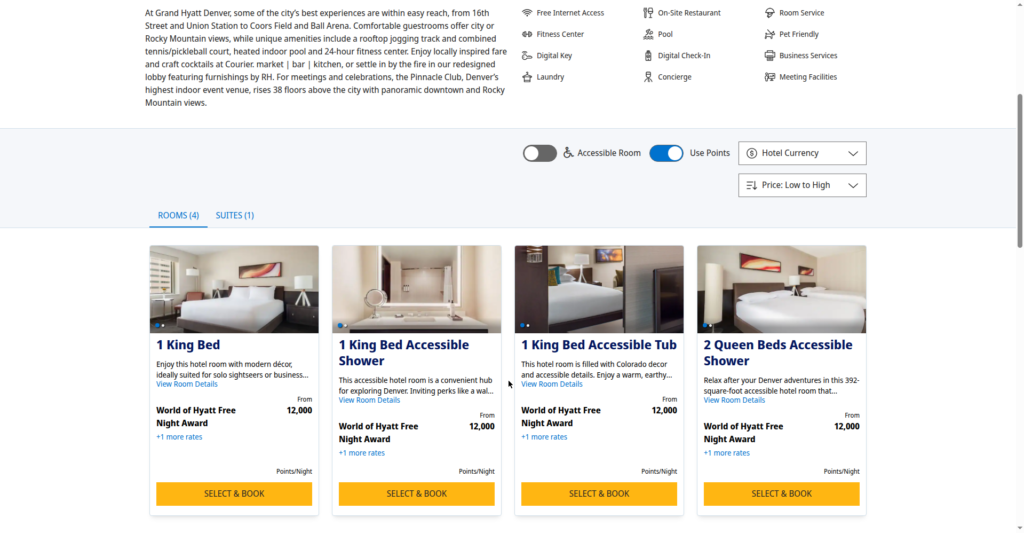
One rule follows from the anchor and applies to the whole post. Price the stay first, then move exactly what the booking needs. Transfers into Hyatt are one-way and final, and Hyatt points expire after 24 months without qualifying activity. A transfer made before a stay is priced is a balance locked into a clock for no reason.
The chart, in two tables
Hyatt groups hotels into Categories 1 through 8. Since May 20, 2026, each category has five levels. The tables below show the Lowest, Moderate, and Top levels for each category, because those three tell you the range. Low sits between Lowest and Moderate, and Upper sits between Moderate and Top, and the captions give both figures for each table.
| Category | Lowest | Moderate | Top |
|---|---|---|---|
| Cat 1 | 3,000 | 6,000 | 9,000 |
| Cat 2 | 6,000 | 10,000 | 15,000 |
| Cat 3 | 8,000 | 15,000 | 20,000 |
| Cat 4 | 12,000 | 20,000 | 25,000 |
Standard room, points per night, Categories 1 to 4. Low levels are 4,500, 7,500, 12,000, and 15,000 in order. Upper levels are 7,500, 12,000, 17,500, and 22,500 in order.
| Category | Lowest | Moderate | Top |
|---|---|---|---|
| Cat 5 | 15,000 | 25,000 | 35,000 |
| Cat 6 | 20,000 | 30,000 | 35,000 |
| Cat 7 | 25,000 | 35,000 | 55,000 |
| Cat 8 | 35,000 | 55,000 | 75,000 |
Standard room, points per night, Categories 5 to 8. Low levels are 20,000, 25,000, 30,000, and 45,000 in order. Upper levels are 30,000, 35,000, 45,000, and 65,000 in order.
A point worth being honest about, because it trips people up: the old Standard price is roughly the new Low level, and the old Peak price is roughly the new Upper level. The new Top level is genuinely new headroom at the top of the chart, and it is where a Category 8 night can reach 75,000 points, up from a 45,000 point ceiling under the old chart. Hyatt has said the move into Upper and Top pricing will be gradual through 2026, with broader adoption later. That means most nights you search today still price at the levels you are used to, but the Top column is the direction of travel, not a theoretical maximum.
Use 1: Low-category nights on Lowest and Low dates
This is the best use of Hyatt points, and it is the one most travelers underuse because it looks unglamorous. Properties in the lower categories, and their cash rates on busy nights, regularly clear the points price by a wide margin. A Category 1 night at 3,000 points on a Lowest date is worth $51 at the anchor. If the flexible cash rate for that room is $150 or more, you are getting 5 cents per point. A Category 4 night at 15,000 points on a Low date is worth $255 at the anchor. If the flexible cash rate is $350, you are getting about 2.3 cents per point.
The comparison must use the final booking screen, with the cheapest flexible rate, all in. Hyatt waives resort and destination fees on award stays, which is a real difference from Marriott and a reason the Hyatt comparison often looks better than it first appears. Taxes are not charged on a pure points stay. That fee waiver is part of the value, not a bonus on top of it, so do not double count it and do not ignore it either.
This use also fits a family road trip better than a luxury stay does. Five nights at Category 4, Moderate, cost 100,000 points, with no fifth night free to reduce the total. That is the honest total, and it is still a strong use if the cash rates for those five nights clear $1,700 all in. If they do not, pay cash, keep the points, and use them where the cash rate is higher.
Use 2: All-inclusive stays in Categories A to C
Hyatt’s Inclusive Collection uses its own chart, lettered A through F, and it is the only major hotel all-inclusive chart that works this cleanly on points. The price covers two guests, with food and drink included, which changes the comparison completely. You are not comparing a room rate to a points price. You are comparing a room, meals, and drinks for two people to a points price.
| All-inclusive | Lowest | Moderate | Top |
|---|---|---|---|
| A | 12,000 | 20,000 | 25,000 |
| B | 15,000 | 25,000 | 35,000 |
| C | 20,000 | 30,000 | 40,000 |
| D | 25,000 | 35,000 | 55,000 |
| E | 35,000 | 55,000 | 75,000 |
| F | 45,000 | 65,000 | 85,000 |
Standard room, points per night for two guests. Low levels are 15,000, 20,000, 25,000, 30,000, 45,000, and 55,000 in order. Upper levels are 22,500, 30,000, 35,000, 45,000, 65,000, and 75,000 in order.
Categories A to C rank above the top categories for one reason: the points price stays low enough that the included food and drink can carry the comparison even on a moderate cash rate. A Category A night at 12,000 points is worth $204 at the anchor, for two people, meals included. A Category F night at 85,000 points on a Top date is worth $1,445 at the anchor, and it needs a very high cash rate to clear that bar.
The family trap in this use is the extra guest rule. The chart prices two guests, not the room. A third and fourth guest each cost extra points per night, generally about half the standard room figure for the same category and level, with a maximum of four people per room. Price the whole party, not the room for two, before you transfer. A Category C stay that looks like 30,000 points a night can become 45,000 points a night for three guests at Moderate, and that changes the test.
Use 3: A luxury night, but only on a low price level
Categories 7 and 8 are where Hyatt points look most impressive on paper, and where they are easiest to waste. A Category 8 night at Lowest costs 35,000 points, worth $595 at the anchor. The same night at Top costs 75,000 points, worth $1,275 at the anchor, and needs a cash rate well above that to win. The hotel is the same. The date is the difference.
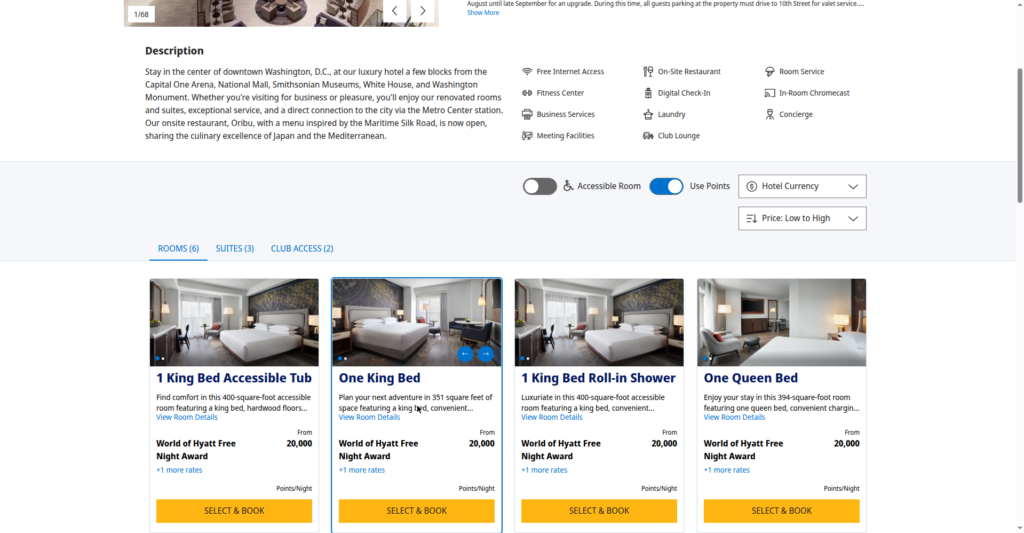
The rule for this use is simple. Book the luxury night only when the price level is Lowest or Low and the flexible cash rate clears the anchor by a margin that survives a price change. Suites and club rooms have their own charts above the standard room chart, so do not assume a suite upgrade costs the standard room price. If the standard room is not available for points, there is no blackout date problem to solve. The room type you want is either in the chart or it is not, and a premium room booked on points is a different purchase.
This is also where a Guest of Honor award earns its keep, if you hold one. A Guest of Honor award gives Globalist in-hotel benefits for a stay of up to seven nights, including free breakfast for registered guests, room upgrades when available, and waived resort fees on eligible rates. Awards are earned as Milestone Rewards starting at 40 qualifying nights, and they are valid for the year earned plus 14 months. They do not change the points price, but they change what the stay is worth once you are there, which is why a luxury night with a Guest of Honor award attached beats the same night without one.
Use 4: Free night certificates, used at the Top level
Hyatt free night awards are worth the most when the night they cover would have cost the most points. A Category 1 to 4 award covers a standard room at any hotel in Categories 1 to 4, at any price level, so its maximum value is a Category 4 night at Top, 25,000 points. A Category 1 to 7 award covers up to Category 7, so its maximum value is a Category 7 night at Top, 55,000 points. Using either award on a Lowest date wastes most of its value. Using it on a Top date is the whole point.
I keep the mechanics of those awards in a separate guide to Hyatt free night awards, including how the Category 1-4 certificates are earned.
The clocks on these awards are short, and they are the reason certificates quietly disappear. Awards earned through the World of Hyatt credit card, including the anniversary night and the night earned at $15,000 in spending in a calendar year, are valid for 12 months. Awards earned as Milestone Rewards, including the Category 1 to 4 award at 30 nights and the Category 1 to 7 award at 60 nights, are valid for 180 days, with checkout on or before the expiration date. The Ultimate Free Night Award, earned at 150 nights, covers Categories 1 to 8, all-inclusive Categories A to F, and Miraval, also for 180 days. A certificate left to expire is the most common way Hyatt value disappears, because unlike points, it cannot be kept alive with a small activity.
Use 5: Points + Cash, when you are short of a full award
Points + Cash is the fifth use, not because it is bad, but because it is a stretch tool. You pay exactly half the points required for a standard award night, plus a cash payment that is 50 to 70 percent off the Standard Rate for the room type. A Category 4 night at Moderate, 20,000 points as a full award, becomes 10,000 points plus a cash copay with Points + Cash. The cash portion is taxed like a paid stay, and Points + Cash availability is capacity controlled, unlike a standard room award, which has no blackout dates. Run the same test as a full award: compare the cash copay plus the value of the points used against the flexible cash rate for the same room. If a discounted cash rate is available, the Points + Cash option can lose to paying cash outright, because its cash portion is tied to the Standard Rate, not the cheapest rate you can find.
How points get into Hyatt, and the routes that do not exist
Only two flexible bank currencies transfer to Hyatt, and the difference between them is now the most important transfer fact in the program. Chase transfers at 1 to 1 from the Sapphire Reserve cards and at 4 to 3 from the Sapphire Preferred and Ink Business Preferred cards, since October 1, 2026. Bilt transfers at 1 to 1 through December 31, 2026, then moves to 4 to 3 for all members on January 1, 2027. American Express, Capital One, Citi, and Wells Fargo have no direct transfer route to Hyatt, so holders of those currencies earn Hyatt points on Hyatt cards, on stays, or by booking Hyatt through another route.
| Source | Ratio | 100,000 Hyatt cost | Notes |
|---|---|---|---|
| Chase Reserve | 1 to 1 | 100,000 points | Instant, 1,000 steps |
| Chase Preferred, Ink | 4 to 3 | 134,000 points | 133,333 rounded up |
| Bilt to Dec 31, 2026 | 1 to 1 | 100,000 points | Moves to 4 to 3 Jan 1 |
| Amex, CapOne, Citi | No direct route | Not available | Use Hyatt cards or stays |
Transfers are one-way and final on every route in this table. Confirm the ratio on your own transfer screen before moving points, and move points through the account with the best rate first.
A practical consequence follows. If you hold Chase points in both a Reserve account and a Preferred account, combine them in the Reserve account before transferring, because the transfer ratio follows the card the points leave from. The same logic applies to Bilt points before January 1, 2027: a Hyatt stay you have already priced is worth funding at 1 to 1 while that rate is still available, and a speculative transfer is still a transfer you cannot reverse.
The 100,000 point worked example
Here is what 100,000 Hyatt points actually buy, at the chart prices above, with no invented hotel price in the math.
| Five nights, Category 4, Moderate, at 20,000 points | 100,000 Hyatt points |
| Value at the 1.7 cent anchor | About $1,700 |
| Chase Reserve points to fund it, at 1 to 1 | 100,000 Chase points |
| Chase Preferred points to fund it, at 4 to 3 | 134,000 Chase points |
| Bilt points to fund it, at 1 to 1 through Dec 31, 2026 | 100,000 Bilt points |
| Five night total, no fifth night free | 100,000 Hyatt points |
The same 100,000 points buy two Category 8 nights at Lowest, 35,000 points each, with 30,000 points left over, or eight Category A all-inclusive nights at Lowest, 12,000 points each, with 4,000 points left over, for two guests. The right choice is not the one that uses the most points. It is the one where the all-in cash rate for the stay you actually want clears $1,700 by the widest margin.
The 5-step playbook
- Search your dates on Hyatt’s site with points toggled on, and note the price level for each night. The category tells you the range. The level tells you the price. A night that drops a level with a one day shift is worth moving for.
- Compare the all-in flexible cash rate for the same room, on the final booking screen. Remember that resort fees are waived on a pure points stay, and taxes are not charged on it. Subtract nothing else, and add nothing else.
- Run the 1.7 cent test. Divide the all-in flexible cash rate by the points price. If the result is below 1.7 cents a point, pay cash. If it clears that bar by a margin that survives a price change, points win.
- Check certificates and Guest of Honor awards before you transfer. A certificate that covers a Top level night, or a Guest of Honor award that adds breakfast and upgrades to a stay, can beat a points booking on its own. Certificates expire, so use the one expiring first.
- Transfer only what the booking needs, through the account with the best rate, last. Combine Chase points in a Reserve account first if you can, and fund a priced Bilt transfer before the January 1, 2027 ratio change if the stay is already booked in your plans. Transfers are one-way and final.
The honest caveats
Hyatt has no fifth night free, and that is the single biggest difference from Marriott, IHG, and Hilton. A five night Hyatt stay costs five nights of points. The chart caps each night, but it does not discount the set. Do not carry a Marriott habit into a Hyatt booking and assume a free night is coming.
Top pricing is the second caveat. Hyatt has said Upper and Top adoption will be gradual through 2026, but the chart now allows a Category 8 night at 75,000 points, and categories are reviewed each spring. A hotel that was Category 7 last year can be Category 8 this year, and a date that priced at Low last year can price at Upper this year. The chart protects you from dynamic pricing, not from category changes or level shifts. Search your dates, every time.
Finally, the transfer routes are narrow. Only Chase and Bilt move points into Hyatt directly, and after January 1, 2027, only the Sapphire Reserve cards will still move them at 1 to 1. That concentration is a risk as well as a feature. If your points sit in American Express, Capital One, or Citi, Hyatt is not a transfer option, and no bonus on another program changes that. Price the Hyatt stay first, then decide whether the points you actually hold can fund it at a rate that clears the test.
My take
Hyatt is the one hotel currency I would transfer flexible points into without a second thought, but only for a stay I have already priced at a level I can defend. I would never move points to Hyatt for a Top level night at a property I picked for the brand, and I would never let a Category 1 to 7 certificate expire while a Top level night sits unused in its window. The program rewards the traveler who checks the level, checks the cash rate, and moves points last. Everyone else is paying a premium for a chart that was supposed to protect them.
Frequently Asked Questions
How much are World of Hyatt points worth?
About 1.7 cents each on an average redemption, with published valuations clustering between 1.65 and 1.8 cents. That means 100,000 points are worth roughly $1,700 in hotel value. Individual stays beat or miss that anchor by a wide margin, so always divide the all-in flexible cash rate by the points price for your dates before booking.
How does the Hyatt award chart work in 2026?
Hotels sit in Categories 1 through 8, and since May 20, 2026, each category has five price levels: Lowest, Low, Moderate, Upper, and Top. A standard room runs from 3,000 points at Category 1, Lowest, to 75,000 points at Category 8, Top. Hyatt does not publish which dates fall at which level, so you learn the level by searching your dates with points toggled on. All-inclusive resorts use a separate chart, Categories A through F, priced for two guests.
Does Hyatt offer a fifth night free?
No. Hyatt has no fifth night free benefit, unlike Marriott, IHG, and Hilton. A five night award stay costs five nights of points, with no night removed from the bill. That makes the per night price level more important at Hyatt than at programs where a longer stay earns a discount.
Which bank points transfer to Hyatt?
Only Chase Ultimate Rewards and Bilt Rewards transfer directly to Hyatt. Chase transfers at 1 to 1 from Sapphire Reserve cards and at 4 to 3 from Sapphire Preferred and Ink Business Preferred cards. Bilt transfers at 1 to 1 through December 31, 2026, then moves to 4 to 3 for all members on January 1, 2027. American Express, Capital One, Citi, and Wells Fargo have no direct route to Hyatt.
Do Hyatt points expire?
Yes, after 24 months without qualifying account activity, such as earning or redeeming points. Any qualifying activity resets the 24 month clock, so a single stay, a card purchase, or a transfer in keeps the balance alive. Free night awards have their own, much shorter clocks: 12 months for card anniversary awards and 180 days for Milestone Rewards awards.
Bottom Line
The best use of Hyatt points is a Category 1 to 4 standard room on a Lowest or Low date, where the points price is low and the cash rate often clears the anchor by a wide margin. The second best use is an all-inclusive stay in Categories A to C, priced for two guests with food and drink included, and the third is a luxury night booked only on a low price level. Free night certificates used at a Top level and Points + Cash when you are short complete the list. Price the stay, check the level, run the 1.7 cent test, and only then move points through the account with the best rate.
Click here for the best cards with the highest welcome offers.
Related Reading
How Much Are World of Hyatt Points Worth? (2026 Guide)
The Best Ways to Spend Marriott Bonvoy Points (2026 Guide)
How to Transfer Credit Card Points to Airlines: The Beginner's Guide (2026 Guide)
Do Airline Miles Expire? The 2026 Guide to Every Expiry Rule
Price the stay first, then move the points. That order is the whole strategy.