

On June 1, 2026, Aeroplan rolls out a new flight reward chart. The headline most blogs will run is “massive partner devaluation.” That’s lazy and, in several places, wrong.
The reality is sharper, more useful, and more actionable: Aeroplan surgically devalued specific partner business class sweet spots — mostly Europe-to-Asia and US-to-deep-Asia — while leaving most of the famous North America-originating sweet spots completely untouched.
If you’ve been sitting on a points balance waiting to book Lufthansa, Swiss, ANA, Singapore, or Avianca business class, this post tells you exactly which routes to lock in before May 31 and which ones you can safely book on the new chart without panicking.
TL;DR
The new chart takes effect June 1, 2026. Partner business class to and from North America in the most common corridors is largely unchanged. The damage is concentrated in three places:
- Europe → Asia partner business (Atlantic-to-Pacific bands): up 15–18%
- US/Canada → deep Asia partner business (the 7,501–11,000 mile band): up 17%
- Long intra-region positioning segments in Asia and Europe: up 17–21%
Several long-haul partner First Class redemptions also got hit by 15–30%, but the practical impact is limited because partner First availability has been almost nonexistent for two years anyway.
The headline number — Air Canada’s own metal in the Atlantic-to-Pacific 7,001+ mile band going from 60,000 to 100,000 points “Starting at” — is real, but it’s an Air Canada / Select Partner change (dynamic pricing), not a fixed partner award change. It still matters, but it’s a different story than “partner devaluation.”
What actually changed for partner business class
Quick reminder on how the Aeroplan chart works: there are two pricing buckets.
- Air Canada and Select Partners (Air Canada, United, Emirates, Etihad, Flydubai, Calm Air, Canadian North, Bearskin, PAL) price dynamically with a “Starting at” floor and a published median.
- All other partners (everyone else — Lufthansa, Swiss, Austrian, Brussels, SAS, Turkish, ANA, Singapore, EVA, Asiana, Thai, Avianca, Copa, and the rest of Star Alliance plus non-alliance partners) price at fixed levels based on distance.
For points enthusiasts in the US and Canada, the “All other partners” column is the one that mattered most. Fixed pricing is what made Aeroplan special. Here’s what changed in that column for business class:
The hardest-hit sweet spots (named routes)
Europe → North Asia (Atlantic ↔ Pacific, 5,001–7,000 miles)
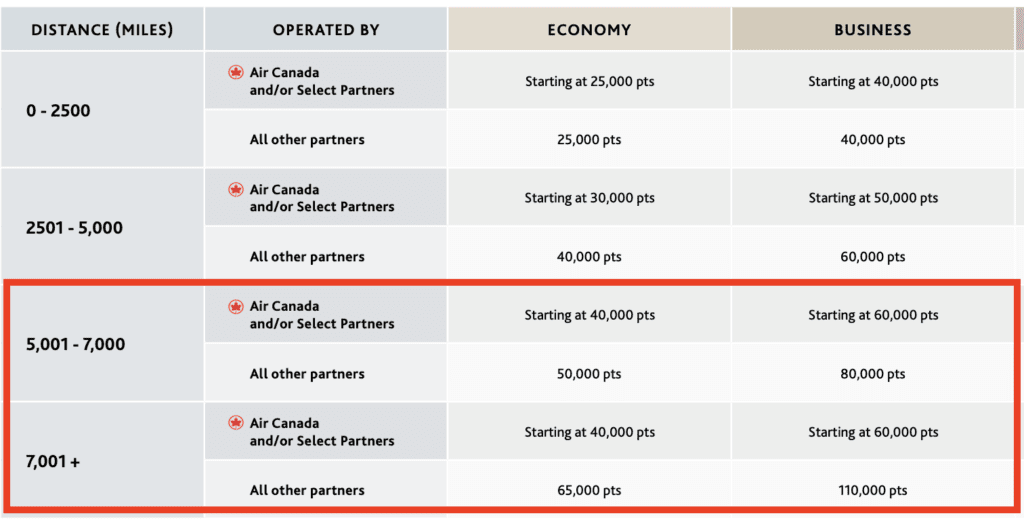
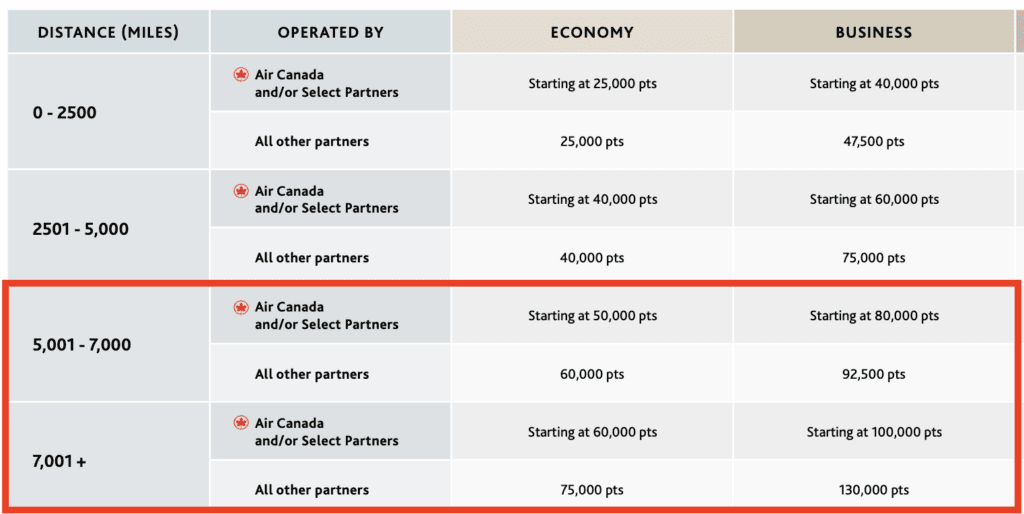
- Old: 80,000 points
- New: 92,500 points
- Change: +15.6%
- Routes affected: Frankfurt, Zurich, Munich, Vienna, Brussels, or Istanbul to Tokyo (Haneda or Narita), Seoul, or Beijing on Lufthansa, Swiss, Austrian, Turkish, Asiana, or Air China business class.
- Why this hurts: for hobbyists who wanted to stitch Europe and Asia into a single trip, this was the most efficient business class option in any major points program. Booking Lufthansa or Swiss FRA-NRT for 80,000 points one-way let you piggyback Asia onto a Europe trip for less than what most programs charge for Europe alone. That math just got 15% worse.
Europe → Southeast Asia / Australia (Atlantic ↔ Pacific, 7,001+ miles)
- Old: 110,000 points
- New: 130,000 points
- Change: +18.2%
- Routes affected: Most European hubs to Singapore, Bangkok, Hong Kong, Sydney, or Melbourne on Lufthansa, Swiss, Singapore, Thai, or partner carriers.
US/Canada → Deep Asia (North America ↔ Pacific, 7,501–11,000 miles)
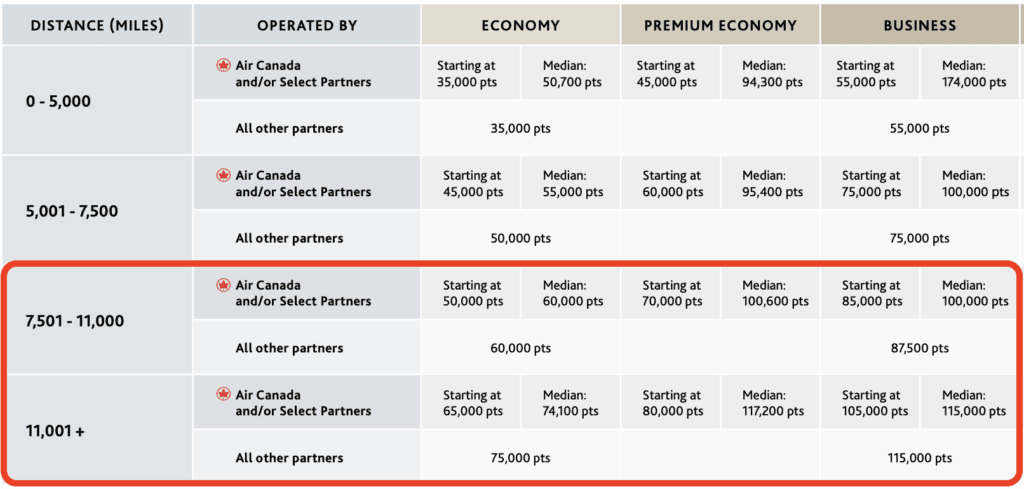
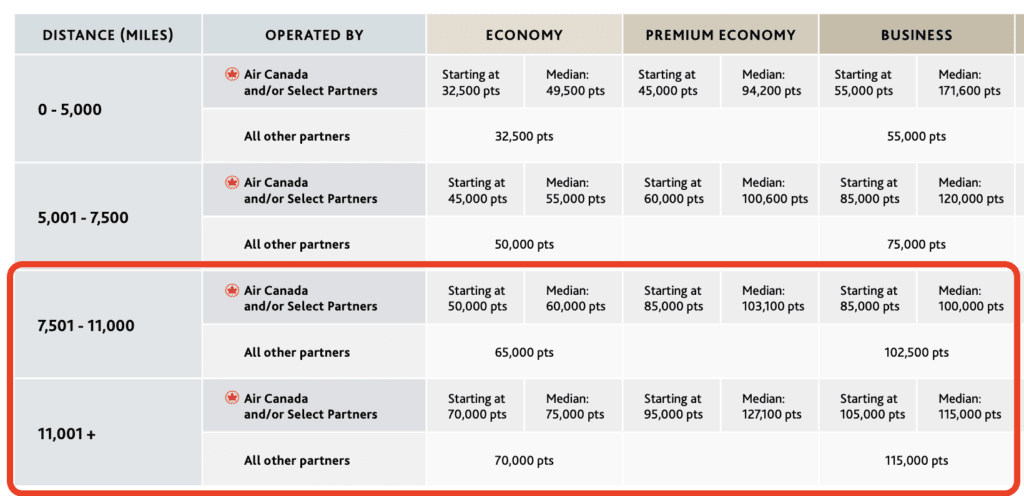
- Old: 87,500 points
- New: 102,500 points
- Change: +17.1%
- Routes affected: LAX, SFO, JFK, ORD, or YVR to Singapore, Hong Kong, Bangkok, or Manila on ANA, Singapore, EVA, or Thai business class.
- Why this hurts: this was the cleanest US-originating partner business sweet spot. ANA business class JFK-NRT-SIN for 87,500 points was a benchmark deal.
US/Canada → Europe, longer routings (NA ↔ Atlantic, 4,001–6,000 miles)
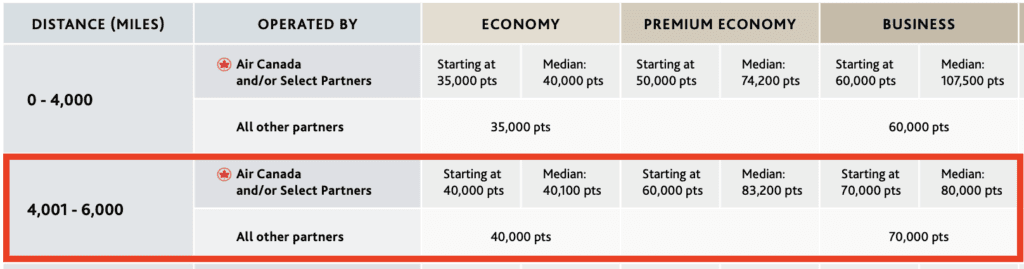
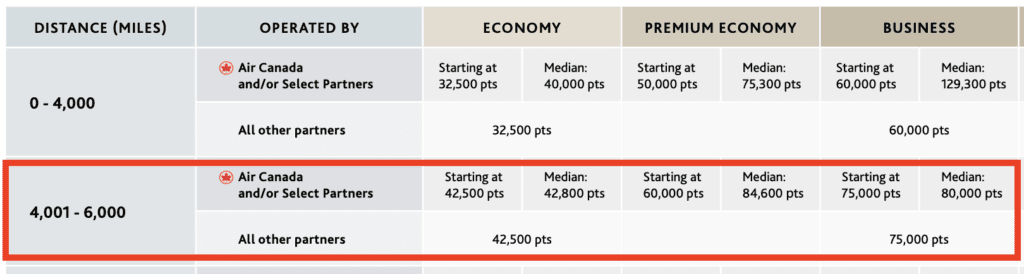
- Old: 70,000 points
- New: 75,000 points
- Change: +7.1%
- Routes affected: Most West Coast and central North America to Europe routings, plus East Coast to Eastern and Southern Europe. Examples: LAX, SFO, SEA, DEN, ORD, YVR, YYC to most European hubs on Lufthansa, Swiss, Austrian, Brussels, SAS, or Turkish business class. Also JFK, BOS, YUL to deeper European destinations like Athens, Istanbul, Warsaw, Prague, or Budapest.
- Why this matters: this is the smallest percentage change in this section, but it affects a huge volume of US/Canada-to-Europe partner business class bookings. If you’re not flying out of the East Coast directly into Western Europe, you’re in this band, not the unchanged 0–4,000 band. 5,000 extra points per direction adds up fast for a family of four.
Intra-Asia long stitching (Pacific zone, 5,001–7,000 miles)
- Old: 60,000 points
- New: 72,500 points
- Change: +20.8%
- Routes affected: Long intra-Asia segments like Tokyo to Singapore, Seoul to Bangkok, Hong Kong to Delhi on partner business. This hits anyone who used to position with a long Asia segment as part of a stopover routing.
Intra-Europe long business (Atlantic zone, 4,001–6,000 miles)
- Old: 60,000 points
- New: 70,000 points
- Change: +16.7%
- Routes affected: Europe to deep Africa or India on Lufthansa, Swiss, Turkish (e.g., FRA-CPT, IST-DEL).
Intra-Atlantic ultra-long business (6,001+ miles)
- Old: 80,000 points
- New: 95,000 points
- Change: +18.8%
- Routes affected: Frankfurt or Zurich to Cape Town, Johannesburg on Lufthansa or Swiss.
What this adds up to
The pattern is consistent. Aeroplan punished partner business class redemptions that don’t originate or terminate in North America. Cross-continental positioning trips (Europe-Asia, Europe-Africa, intra-Asia, intra-Europe long-haul) all got hit by 15–21%.
This is not random. These are exactly the routes that sophisticated points users were stitching together with stopovers to extract maximum value from a single award. Aeroplan saw the play and adjusted pricing to recapture margin.
What survived (and you can still book confidently)
This is the part most blogs will skip, and it’s the most useful section of this post. Several of the most popular US/Canada-originating partner business class sweet spots did not change at all.
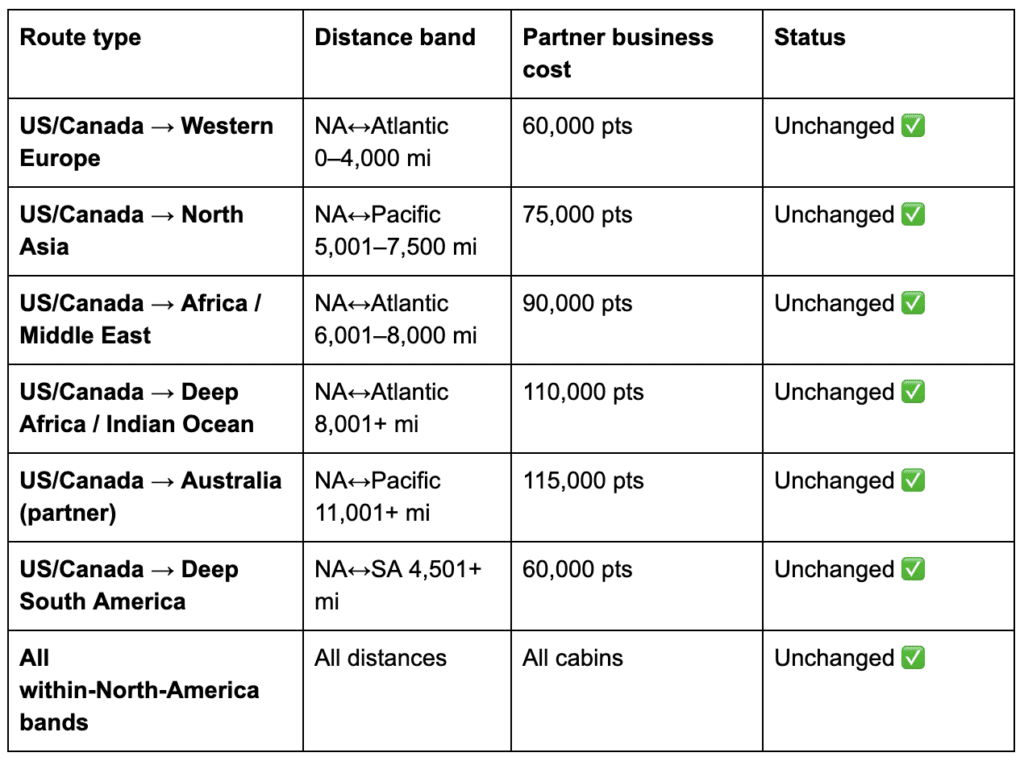
Read that table again. The most commonly cited US-originating Aeroplan sweet spots — JFK to Frankfurt on Lufthansa business for 60,000 points, ORD to Tokyo on ANA business for 75,000 points, Miami to São Paulo on Avianca business for 60,000 points — are all completely intact.
If you’ve been worried about losing the “lock in Aeroplan for partner business out of the US” play, you mostly haven’t lost it. You’ve lost it specifically for trips that route through Europe to Asia, or that go to Singapore/Hong Kong/Bangkok directly.
What to book before June 1
If you have the points and you’ve been sitting on a trip in any of these categories, book it now on the current chart:
- Any Europe-to-Asia business class redemption. This is the single biggest delta. 80,000 vs 92,500 on a Lufthansa or Swiss FRA/ZRH-NRT/ICN trip is 12,500 points saved per ticket, per direction.
- US/Canada to deep Asia (Singapore, Hong Kong, Bangkok) on partner business. 87,500 vs 102,500 on ANA, EVA, Thai, or Singapore. 15,000 points saved per ticket, per direction.
- Anything that uses a long intra-Asia or intra-Europe positioning segment, especially as part of a stopover routing.
- US/Canada to Europe on Partner Business (4,001 – 6,000) – Jumps from 70,000 to 75,000 one way business class. Ruotes like Toronto, Chicago to Western Europe fall in this bucket.
- Long-haul partner First Class if (and this is a big if) you can actually find availability. Lufthansa First, Swiss First, ANA First — all up 15–30% in the new chart.
Aeroplan allows bookings up to 355 days out, so if you can pin down rough dates, this is your window. Award changes hit at the time of new booking on or after June 1, so anything ticketed before May 31 is locked in at current pricing.
Alternative programs for the dying sweet spots
If you don’t have enough Aeroplan points to lock in your trip before June 1, the better question is: is Aeroplan still the cheapest program for this redemption after June 1? Sometimes the answer is no.
- Lufthansa, Swiss, Austrian, Brussels business class: Avianca LifeMiles often prices these in the same range or cheaper than the new Aeroplan numbers, depending on the route.
- ANA business class US to Asia: ANA’s own Mileage Club program prices ANA flights cheaper than Aeroplan does, though it requires round-trip booking and has tighter rules.
- Singapore, EVA, Thai business class: Singapore KrisFlyer and other Star Alliance programs (Turkish Miles&Smiles, Avianca LifeMiles) are worth comparing.
- Star Alliance to Asia in business: United MileagePlus has dynamic pricing for United but partner award space exists in their inventory and pricing to Asia and Africa costs only 80K United Miles.
- Air France and KLM business class to Europe: Flying Blue is a separate ecosystem entirely — and a strong alternative for transatlantic business if you can collect Flying Blue miles via transfer.
The point: don’t default to Aeroplan just because you have the points. After June 1, on several routes, it’s no longer the best deal in the room.
The bigger lesson: don’t lock all your points into one program
Here’s the honest takeaway from this devaluation cycle.
Aeroplan was, for years, the single best program to park transferable points in if you were chasing partner business class. The fixed-price chart, the no-fuel-surcharge policy, and the generous routing rules made it a no-brainer. A lot of people responded by transferring everything they had into Aeroplan and treating it as a vault.
That strategy just got expensive. When a single program devalues — and Aeroplan won’t be the last — you have no leverage. You can’t shop the redemption to a competing program because your points don’t exist anywhere else.
The fix is to keep your points in transferable currencies for as long as possible, and only transfer when you’re ready to book. That way one program’s devaluation is just a cue to compare options, not a direct loss.
For Canadians
The two transferable currencies that actually matter for airline diversification:
- American Express Membership Rewards (Canada) transfers 1:1 to Aeroplan, British Airways Avios, and Flying Blue (Air France/KLM) — among others. That single currency gives you access to three completely separate award charts: Aeroplan for Star Alliance, Avios for the oneworld carriers (American, British Airways, Iberia, Qatar, Cathay, Finnair, JAL, Qantas), and Flying Blue for SkyTeam (Air France, KLM, Delta, Virgin Atlantic).
- RBC Avion transfers to British Airways Avios (1:1), Cathay Asia Miles, and WestJet Rewards. Avion is the Canadian backdoor into Avios and into the Cathay ecosystem.
If you hold both, you can book Star Alliance, oneworld, SkyTeam, and Cathay business class — without ever being forced to live or die by Aeroplan’s chart. That’s the position you want.
For Americans
The US has more transferable currency programs than Canada, and most of them transfer to multiple airline partners. Without naming specific issuers, the strategic move is the same: hold points in transferable currencies, not parked inside any single airline program. Diversify across two or three transferable rewards ecosystems and you’ll have access to virtually every meaningful airline loyalty program — Aeroplan, Avios, Flying Blue, ANA, Singapore KrisFlyer, Avianca LifeMiles, and more.
Check Out My Card Explorer Tool Here
Bottom line
This isn’t an Aeroplan apocalypse. It’s a targeted devaluation of partner business class on Europe-to-Asia and US-to-deep-Asia routes, plus long intra-region segments. The most popular US-originating sweet spots — Western Europe, North Asia, Africa, South America — are unchanged.
But it’s also a reminder. Every fixed-price chart eventually moves. Every program eventually devalues. The points users who keep options open by holding transferable currencies are the ones who shrug when this kind of news drops. The ones who parked everything in a single program are the ones who feel it.
Book what you need to book before June 1. Then think hard about how your points are distributed.
View comments
+ Leave a comment