

Both premium cards just got a lot more expensive. The Chase Sapphire Reserve now carries a $795 annual fee. The Amex Platinum sits at $895. For most people weighing the two, the single biggest question is the same: how much of that fee do the hotel credits actually claw back?
The face-value math makes CSR look like the obvious winner. $1,050 in annual credits versus Amex’s $600? Case closed.
Except that’s not how any of this actually works.
Once you separate true hotel credits from flexible travel credits, account for minimum-stay requirements, factor in how the on-property benefits actually compare, and look at where each program’s properties are concentrated — Amex Platinum wins for most travelers, despite offering less face value.
Watch The Video Version of This Post Here
This post walks through exactly why, with the math. I’ll also tell you the specific profile where CSR is actually the right call (it exists, it’s just narrower than most comparison posts suggest). For a deeper dive on how to stack all three CSR hotel credits, I’ve got that in my Chase Sapphire Reserve hotel credits guide.
The Real Comparison (Not the Face-Value One)
Most comparisons stack up the credits like this:
- CSR: $1,050
- Amex Platinum: $600
That’s misleading. Here’s the honest breakdown:
Chase Sapphire Reserve hotel-related credits:
- $300 annual travel credit — this is a flexible travel credit, not a hotel credit. Applies to flights, parking, rideshares, trains, and any travel purchase. It doesn’t belong in the hotel comparison.
- Two $250 credits for The Edit — $500 recurring annual hotel value
- $250 Select Hotel credit (2026 only) — $250 one-time, not confirmed for 2027
Amex Platinum hotel credit:
- $600 annual FHR/THC credit — $300 semi-annually, recurring every year
The honest hotel-credit math:
- CSR recurring annual hotel value: $500
- Amex Platinum recurring annual hotel value: $600
Amex wins by $100 in recurring hotel value. The $250 one-time Select Hotel credit bumps CSR ahead for 2026 only. If Chase doesn’t renew that credit in 2027, CSR permanently drops behind.
This is the first thing most comparison posts get wrong. They count the $300 travel credit as “hotel value” and pretend the 2026-only Select Hotel credit is a permanent benefit. Neither is true.
Where CSR’s Credits Get Harder to Use
The value gap gets wider when you look at how the credits actually trigger.
CSR Edit credits require:
- Prepaid booking through Chase Travel
- Two-night minimum stay
- A property in Chase’s Edit collection
- Chase Travel’s pricing (not always competitive with direct booking)
Amex FHR credits require:
- Prepaid booking through Amex Travel
- No minimum stay — one night works
- A property in the Fine Hotels + Resorts program
The one-night flexibility is not a small detail. It’s the single most important structural difference between the two programs.
The $400 Property Example
Say you find a luxury hotel you want to try for one night — a city stopover, a spa weekend, a one-night anniversary stay.
At $400/night on Amex FHR:
- Book one night: $400
- $300 FHR credit applies
- Out of pocket: $100
- You get: breakfast for two, $100 on-property credit, room upgrade if available, 4 PM guaranteed checkout
Same property at $400/night on The Edit:
- Must book two nights: $800
- $250 Edit credit applies
- Out of pocket: $550
- You get: breakfast for two, $100 on-property credit, room upgrade if available, late checkout if available
That’s a 5.5x difference in cash outlay for effectively the same property experience. And this assumes Chase Travel is pricing the property competitively, which isn’t always the case. Chase Travel has a documented history of rates that run higher than direct booking or competitor portals.
For shorter trips and one-night luxury stays, CSR’s credits are much harder to deploy without overspending. Here is an example of the Pendry Hotel In Chicago that is part of both American Express Fine Hotels & Resorts as well as Chase’s The Edit Collection.
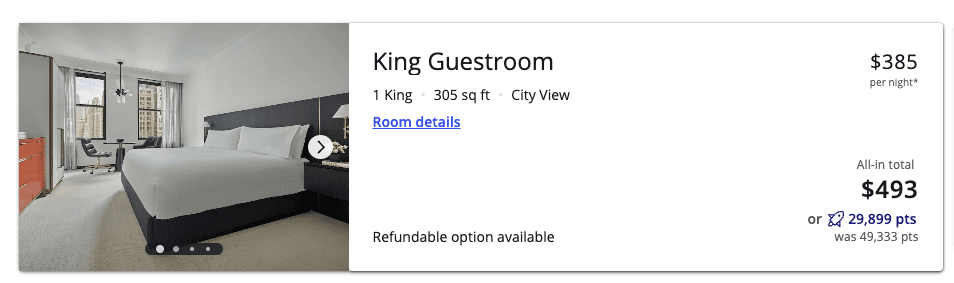
A one night stay using Chase’s the Edit cost $493, since you need a two night minimum you will have to book a stay that costs $984. This will trigger the $250 credit leaving you USD $734 out of pocket.
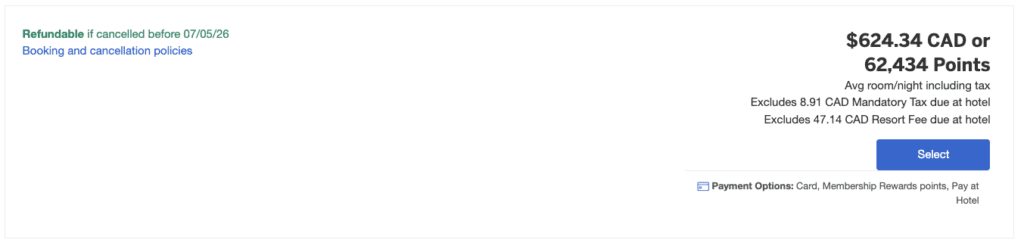
When booking through American Express Fine Hotels + Resorts, the total comes out to $484 USD per night including resort fees. Not only is that slightly cheaper than booking through Chase, but you can also take advantage of the $300 annual credit.
If you book just one night, you can apply the full $300 credit, bringing your out-of-pocket cost down to just $184.
Even if you book the full two-night stay through Amex FHR, the math still works in your favor. Two nights would cost $968 total, and after applying the $300 credit, your net out-of-pocket drops to $668.
That’s lower than the $734 you’d pay through Chase—and on top of that, you’ll get stronger on-property benefits, like guaranteed 4 PM checkout.
On-Property Perks: FHR Has Small But Real Edges
Both programs give you elite-like perks when you book. The benefit lists are similar, but two differences matter:
Fine Hotels + Resorts (per stay):
- Daily breakfast for two (minimum $60 per room per day)
- $100 on-property credit (varies by property)
- Room upgrade when available
- 12 PM check-in when available
- Guaranteed 4 PM late checkout
- Complimentary Wi-Fi
The Edit by Chase (per stay):
- Daily breakfast for two
- $100 on-property credit
- Room upgrade when available
- Early check-in when available
- Late checkout when available (not guaranteed)
- Complimentary Wi-Fi
The guaranteed 4 PM checkout is the one that matters. If you’ve ever needed that extra half-day before a redeye, or wanted to use the spa on your last morning without an 11 AM eviction, you know exactly what this is worth. FHR gives it to you contractually; Edit gives it to you if the hotel feels like it.
One point in Edit’s favor worth acknowledging: Amex explicitly prohibits back-to-back FHR stays at the same property — you can’t book two consecutive one-night stays to get two $100 credits. Per Amex’s FHR terms, consecutive stays at the same property within 24 hours are considered one stay for benefits purposes. The Edit is more lenient here, and some travelers have been able to stack credits across separate reservations at the same property. This is a niche play, but it’s real.
Sources: Amex FHR terms (americanexpress.com/en-us/travel/fine-hotels-and-resorts) and Chase Edit benefits per the Chase Travel portal.
The Property Count Comparison
Credits and perks don’t matter if the program doesn’t have properties where you actually travel. Here’s how the two programs stack up by continent:
Table is now clean — no asterisks, no footnotes mixing groupings. Final numbers:
| Continent | Amex FHR | Chase Edit | Difference |
|---|---|---|---|
| North America | 552 | 698 | Edit +26% |
| Europe | 562 | 427 | FHR +32% |
| Asia & Oceania | 356 | 189 | FHR +88% |
| Middle East & Africa | 133 | 58 | FHR +129% |
| South America | 39 | 21 | FHR +86% |
| Total | 1,642 | 1,393 | FHR +18% |
Sources: awardtravel.co FHR list (Jan 2025, 1,642 properties) and Chase Travel portal country filters (April 2026, 1,393 properties).
What the numbers actually tell you
Chase Edit is larger in North America only. Everywhere else, FHR dominates — significantly so in Asia, the Middle East, Africa, and South America. FHR has 15% more properties overall, and those properties are concentrated in the international destinations where the luxury hotel experience is often the whole point of the trip.
If you mostly travel domestically and in the Caribbean, Edit has a deeper roster. If you travel internationally at all, FHR is the wider program.
The Break-Even Math, Done Honestly
Let’s cut through the “total card value” nonsense. Here’s what each card actually returns on hotel credits when used normally.
CSR realistic utilization:
| Credit | Realistic use | Value captured |
|---|---|---|
| First $250 Edit credit | Likely | $250 |
| Second $250 Edit credit | Maybe | $125 (50% likelihood) |
| $250 Select Hotel credit (2026 only) | Possible | $125 (50% likelihood) |
| Realistic 2026 hotel total | ~$500 | |
| Realistic 2027+ hotel total (if Select Hotel credit doesn’t renew) | ~$375 |
Amex Platinum realistic utilization:
| Credit | Realistic use | Value captured |
|---|---|---|
| H1 $300 FHR/THC credit | Likely | $300 |
| H2 $300 FHR/THC credit | Likely | $300 |
| Realistic annual hotel total | ~$600 |
Hotel credits alone don’t justify either card’s annual fee. That’s true of every premium travel card on the market — credits are one factor, and they work in combination with earning rates, lounge access, elite status benefits, and transfer partners. What matters here is the relative hotel value between the two cards: Amex Platinum delivers more realistic annual hotel value, more consistently, on a recurring basis.
The Verdict: Amex Platinum Wins for Most People
For the hotel credit question specifically, Amex Platinum is the better card for most travelers. Here’s why:
- More recurring annual hotel value ($600 vs $500, growing to $600 vs $375 if CSR’s 2026 one-time credit isn’t renewed)
- No minimum stay — one-night luxury stays work with FHR, not with Edit
- Guaranteed 4 PM checkout vs availability-based late checkout
- Larger international property footprint — especially for Europe, Asia, Middle East, Africa, and South America travel
- Simpler credit structure — two $300 semi-annual credits are easier to use than three separate credits with different rules
Who Should Still Pick CSR
CSR is the right call for a specific traveler profile:
- You travel primarily in North America (where Edit has 26% more properties)
- You regularly book multi-night luxury stays at cash rates anyway
- You’ll use Chase Travel comfortably despite its pricing inconsistencies
- You’ll deploy both $250 Edit credits and the $250 Select Hotel credit in 2026
- You value Chase’s transfer partners (particularly Hyatt, which remains the best points-per-dollar hotel transfer in the ecosystem)
If you fit most of that profile, CSR wins. If you don’t, Amex Platinum is the better hotel credit card.
One More Thing
Neither card should be evaluated on hotel credits alone. Points earning, lounge access, transfer partners, and lifestyle credits all matter. But for the specific question of “which card returns more hotel value,” the answer for most travelers is Amex Platinum — by a meaningful margin once you account for utilization reality.
For the full breakdown of stacking all three CSR hotel credits on a single stay — and how to squeeze every dollar from the card before deciding whether to keep it — see my Chase Sapphire Reserve hotel credits guide.
View comments
+ Leave a comment