
If you hold points in more than one bank program, you have seen the emails. ‘Get 25% more when you transfer to Flying Blue.’ ‘70% bonus to Marriott, ends October 15.’ They read like free points, and sometimes they are. But the bonus is never the deciding factor, and most advice about them gets the order of operations backwards.
The short version: a transfer bonus is a limited-time offer that adds extra miles or points when you move flexible credit card points (Chase Ultimate Rewards®, American Express Membership Rewards®, Capital One miles, Citi ThankYou®) to a specific airline or hotel partner. Bonuses usually run 10 to 50%, though hotel offers occasionally hit 70%. The offer lasts weeks, not months, and the math only works if you already have an award priced out. A bonus on a booking you would make anyway is free money. A bonus that moves points without a booking creates a stranded balance you can never move back.
Here is how transfer bonuses actually work, every offer running right now, the five rules I follow before I use one, and the honest caveats. Including the one where the biggest bonus this month is also the worst deal for most people.
Click here for the best cards with the highest welcome offers.
TL;DR: transfer bonuses live in October 2026
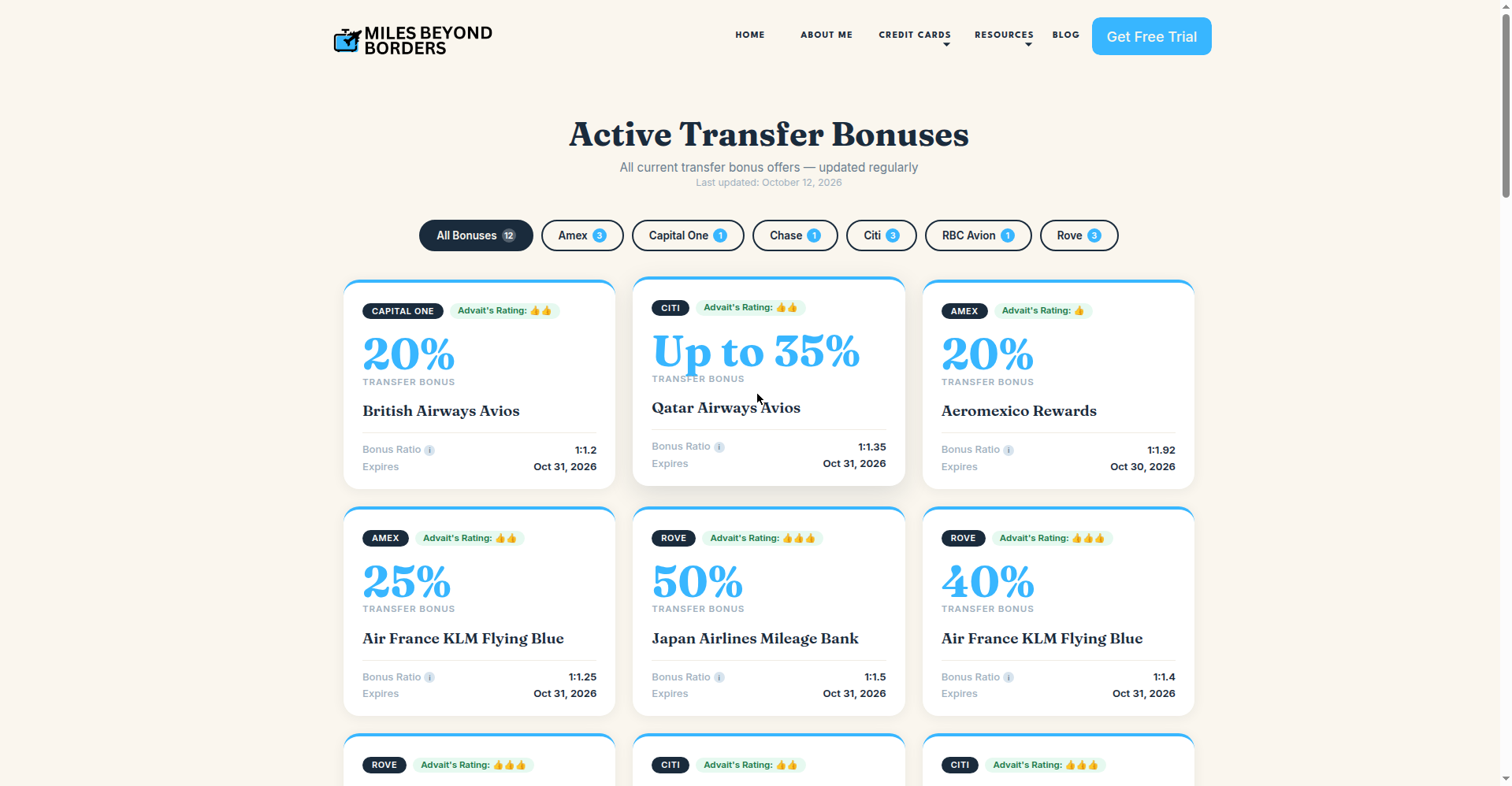
Bonuses change every month. These are the offers running as of today, October 12, 2026. Check my transfer bonus tracker before you move anything, since end dates shift.
| Bank | Partner | Bonus | Ends |
|---|---|---|---|
| Amex | Hilton Honors | 30% | Oct 14 |
| Chase | Marriott Bonvoy | 70% | Oct 15, 11:59pm ET |
| Citi | Avianca LifeMiles | 25% | Oct 24 |
| Citi | JAL Mileage Bank | 30% | Oct 24 |
| Amex | Aeromexico Rewards | 20% | Oct 30 |
| Amex | Air France/KLM Flying Blue | 25% | Oct 31, 11:59pm MT |
| Capital One | British Airways Club | 20% | Oct 31 |
| Citi | Qatar Privilege Club | Up to 35% (tiered) | Oct 31 |
Offers verified October 12, 2026 against multiple coverage sources. The Capital One to British Airways bonus runs through October 31 at 11:59pm ET per BA’s partner page terms.
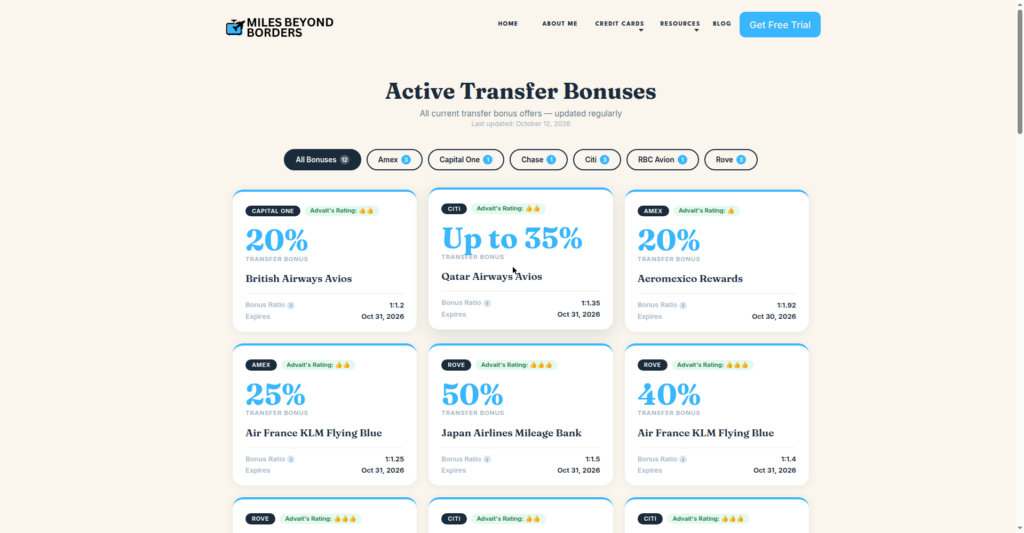
A point worth being honest about, because it trips people up: the table above is a snapshot, not a reference. Bonuses are monthly inventory. The mechanics below are the part that stays true every month, and they are what this guide is really about.
What a transfer bonus actually is
Your bank points normally move to partners at a fixed base ratio, most often 1:1. Transfer 10,000 Chase points to United, get 10,000 United miles. A transfer bonus changes that ratio temporarily. During Amex’s current 25% bonus to Flying Blue, 1,000 Membership Rewards points become 1,250 Flying Blue miles instead of 1,000.
There are two flavors, and the difference matters.
Bank-side bonuses come from the bank. Amex adds the extra miles to your transfer, so you see 1,250 on the transfer screen and the miles land in one batch. Most airline bonuses work this way.
Partner-side bonuses come from the airline or hotel program. The Citi to Qatar offer this month is a Qatar promotion, so Citi’s screen shows the plain 1:1 ratio and Qatar adds the bonus separately. Qatar says the bonus Avios post by November 30, which means your bonus may not exist on the day you book. On a trip you need to ticket now, that lag kills the whole plan.
What a 25% bonus actually saves
Here is the arithmetic most coverage skips: a 25% bonus does not save you 25% of your points. It cuts the points you need for an award by 20%.
The formula is simple. Award price divided by (1 + bonus). A 60,000-mile award at a 25% bonus costs 48,000 bank points, because 48,000 times 1.25 equals 60,000.
| Bonus | Points for a 100k award | Points you save |
|---|---|---|
| 20% | 83,333 | 16,667 (16.7%) |
| 25% | 80,000 | 20,000 (20%) |
| 30% | 76,923 | 23,077 (23.1%) |
| 35% | 74,074 | 25,926 (25.9%) |
| 70% | 58,824 | 41,176 (41.2%) |
Math assumes the standard 1:1 base ratio. Bonuses with a different base ratio (Amex to Hilton at 1:2, Citi no-fee cards at 1:0.7) scale differently.
Two worked examples from this month’s live offers.
Amex to Flying Blue at 25%: Flying Blue prices one-way business class between the US and Europe from 60,000 miles on its Light fares. At the 25% bonus, that award costs 48,000 Amex points (60,000 divided by 1.25), plus whatever taxes and fees Flying Blue adds, which run high on this program. Check the award screen for the all-in number before you move anything.
Citi to Qatar at the top 35% tier: move 100,000 Citi ThankYou points in a single transaction and you land 135,000 Avios. A QSuites business-class seat from the US to Doha prices from 70,000 Avios off-peak, so that one transfer covers the seat with 65,000 Avios left over. I want to be careful here. That 70,000 number is the starting price, and QSuites award seats are the hard part. Price the exact flight and confirm the seat exists before the bonus does any talking.
The five rules I follow before touching a bonus
These are the same five rules every month, whatever the numbers are.
- Find the award first, transfer second. Search the airline or hotel site, find the seat or room, note the exact price. Transfer only what that booking needs. A bonus is a discount on a transfer you already planned. It is never a reason to move points.
- Check the transfer time, not just the end date. Amex tells you transfers to Flying Blue can take up to 48 hours. Qatar’s bonus Avios post by November 30, not instantly. Chase to Marriott’s bonus portion posts up to seven days after the base points. A bonus you cannot use before the award disappears is not a bonus.
- Transfer in one transaction when tiers exist. Qatar’s bonus is tiered per transaction: 15% below 50,000 Avios, 25% from 50,000 to 99,999, 35% at 100,000 or more. Two separate 50,000-point transfers land at the 25% tier and produce 125,000 Avios total. One 100,000-point transfer lands at 35% and produces 135,000. Splitting costs you 10,000 Avios. Plan the single move before you click.
- Compare against what those points would do elsewhere. This is the rule that kills most “great” bonuses. Chase to Marriott at 70% is the biggest number this month. It is also, for most people, the worst deal, because Marriott points are worth roughly 0.7 cents each while the same Chase points sent to United, Flying Blue, or Virgin Atlantic routinely return far more. If you are topping up a Marriott balance for a stay you have already priced, it is a great deal. If you are building a Marriott balance from scratch because 70% looks big, you have traded valuable points for less.
- Read the small print on your card tier. Citi’s no-annual-fee cards transfer to Qatar at 1:0.7, not 1:1. The 35% bonus multiplies the smaller base: 100,000 points become 70,000 Avios, then 94,500 with the bonus, not 135,000. Minimums are typically 1,000 points, increments of 1,000, and the names on both accounts must match.
The honest caveats
Not every redemption is worth it, even with a bonus attached. That is the whole reason to do the math first: a bonus makes a good booking cheaper, it does not make a bad booking good. The 70% Marriott number is the clearest case this month, big headline, weak economics, unless you have the stay priced.
A second note on the Capital One to British Airways date: a few outlets still print October 21, but BA’s own partner page terms say the bonus runs through October 31 at 11:59pm ET, and I confirmed October 31 on my own transfer screen. Either way, check the bonus on the transfer screen in your own account before confirming.
A third: speculative transfers lock in a downgrade. Bank points sit on flexible balances with generous rules. The moment they land at a partner, they adopt that program’s expiry clock and its restrictions. Flying Blue miles expire with 24 months of inactivity; Marriott points expire after 24 months without earning activity. Points you move ‘because the bonus might be useful later’ start a countdown the day they land.
My take
Transfer bonuses are one of the few genuinely free lunches in this hobby, but only when the booking comes first. My rule is boring: one priced award, one transfer, never stockpiling.
This month, the standouts for a real plan are Amex to Flying Blue at 25% if you have a US to Europe award priced out, and Citi to Qatar if you can make the full 100,000-point tier in a single transaction. The Chase to Marriott 70% deserves a pass from almost everyone unless you are topping up for a stay you have already found. Bonuses change every month, so bookmark my transfer bonus tracker and check it before you move anything.
Frequently asked questions
Is the bonus automatic, or do I need to register?
Most transfer bonuses apply automatically when you transfer during the window. Bank-side bonuses show on the transfer screen before you confirm, so check the math there. Partner-side bonuses, like Qatar’s this month, do not show up at the bank at all and post separately, so confirm the partner’s promo page before you transfer.
Can I transfer my miles back to the bank?
No. Every program’s terms say the same thing: transfers are one-way and irreversible. Once points leave Chase, Amex, Capital One, or Citi, they stay at the partner. This is why the booking comes first.
Do no-annual-fee cards get transfer bonuses?
Usually yes, but the bonus applies to a worse base ratio. Citi’s no-annual-fee cards transfer to Qatar at 1:0.7 instead of 1:1, so a 35% bonus on 100,000 points produces 94,500 Avios, not 135,000. Always check your card’s ratio before doing the math.
Is a bigger bonus always better?
No. A 25% bonus to a program where your points are worth 1.5 cents or more usually beats a 70% bonus to hotel points worth 0.7 cents each. Compare the points cost of your actual booking with and without the bonus, and against what those points would buy at another partner.
How do I find out about new transfer bonuses?
I keep a live list at milesbeyondborders.com/transfer-bonuses, updated as offers start and end. Banks announce bonuses by email and on their transfer pages, but the window is usually measured in weeks, so check the tracker before you plan any transfer.
The bottom line
A transfer bonus is a discount on a transfer you were already going to make. Price the award, check the transfer time and the tier rules, move exactly what the booking needs in one transaction, and ignore the headline number in favor of your own math. Do that and the bonuses are free money. Skip it and they are the fastest way to strand points somewhere they are worth less.
Choose the booking first. Let the bonus come to you.
Related reading: How to Transfer Credit Card Points to Airlines: The Beginner’s Guide · Citi to Qatar Avios: The Up-to-35% Transfer Bonus · Transfer Bonus Tracker
View comments
+ Leave a comment